

More search traffic won’t help if the calls are for work you don’t take or crews you can’t schedule. Tree service SEO should make it easier for suitable customers to find the services you want to book, then connect that visibility to estimates, scheduled jobs, and crew capacity.
Rankings and traffic reports show activity, but they don’t tell you whether an inquiry is qualified, whether the job fits your equipment and schedule, or whether it turns into booked work. To judge SEO’s value, connect search activity to the calls, estimates, and jobs your team handles.
This guide explains how your website, Google Business Profile, and map pack visibility fit into tree service SEO. You’ll learn how to prioritize pages around the work you want, and how to assess search visibility alongside qualified inquiries, cost per lead, close rate, backlog, and crew capacity.
Key Takeaways
- Tree service SEO works best when your service pages match the jobs you want to schedule and the areas you serve.
- Separate organic search, Google Maps visibility, and paid placements in your reporting so you can see how each channel contributes.
- Track the path from search impressions and clicks to inquiries, estimates, and booked jobs to find where prospects drop off.
- Prioritize improvements to existing pages, business details, contact paths, and tracking before adding more work.
- Coordinate SEO with your Google Business Profile, website, and paid campaigns while keeping ownership of your marketing assets.
Tree Service SEO Connects Search Visibility to the Work You Want
You may show up for a broad tree-related search and still get calls for work you don’t perform, jobs outside your service area, or projects your crews can’t schedule. Tree service SEO should help relevant pages appear in organic search when people are looking for work your company handles. Visibility is the first step, not the finish line.
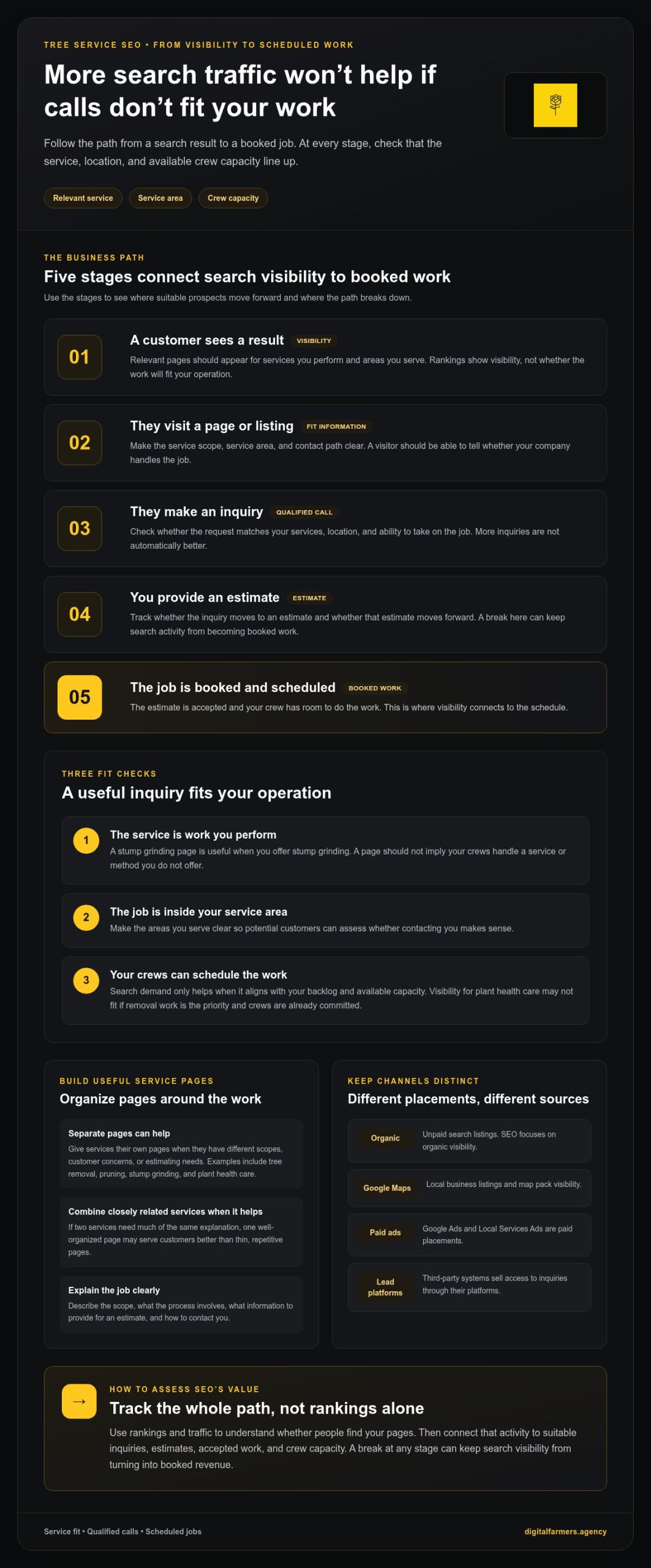
Search results can include several channels. Organic results are unpaid listings that appear because a page is relevant to the search. Google Maps visibility includes local business listings and the map pack. Google Ads and Local Services Ads are paid placements, while third-party lead platforms sell access to inquiries through their systems.
SEO focuses on organic visibility. It draws on the broader practice of search engine optimization, but the business goal is specific: help the right pages get found for the services and service areas your crews can support.
What tree service SEO covers
Search engines need to access and understand your website pages. Those pages need accurate service information, and your business details should be consistent wherever customers find you. Tracking then helps connect organic visibility to site visits and inquiries, rather than leaving you with rankings alone.
A page about stump grinding should explain that service clearly. A page about crane-assisted removal should help customers understand that your company handles that type of work. Publishing a page for every phrase someone might search is not the goal. Useful pages reflect the work you actually do, the areas you serve, and the jobs you want to estimate.
SEO doesn’t buy placement in organic results, and it doesn’t sell you another company’s inquiries. It builds the route from a relevant search to information on your own website. That route depends on the page meeting the search need and giving a potential customer a clear next step.
Why visibility alone does not fill the schedule
The business path has several steps: a customer sees a result, visits a page or listing, makes an inquiry, receives an estimate, and books the work. A break at any step can keep visibility from turning into revenue. The service must fit, someone needs to handle the inquiry, the estimate must move forward, and the crew needs capacity to do the job.
For example, visibility for plant health care may be useful if you offer it and have room in the schedule. It may be a poor fit if your current priority is removal work and crews are already committed. Search demand only helps when it aligns with your services, backlog, and available capacity.
- Relevant visibility: Searchers see pages for services you perform in areas you serve.
- Qualified inquiry: The request fits your work, service area, and ability to take on the job.
- Booked work: The estimate is accepted and the job can be scheduled.
Search position is not the same as booked work. Rankings and traffic can help diagnose whether people are finding your pages, but they don’t prove the inquiries are suitable, estimates are closing, or the work is profitable. Track the whole path, then use the results to judge whether search visibility supports your operation. For a broader framework, see this tree company lead generation strategy for connecting inquiries to estimates and booked work.
How Tree Service SEO Connects Search Needs to Useful Service Pages
A homeowner looking for stump grinding needs different information from someone comparing pruning options. Your website should make that distinction clear. Focused service pages help search engines connect a specific need with relevant information, while helping customers decide whether your company may be a fit. See this guide to tree service website design for practical guidance on building pages around your services and making contact details easy to find.
Search engines discover pages by following links and examining the information on them. Clear page titles, headings, and service descriptions help show what each page covers. You don’t need to repeat the same phrase throughout the page. Describe the work accurately and answer the questions a potential customer needs resolved before calling.
Organize pages around the services you perform
Give distinct services their own pages when they have different scopes, customer concerns, or estimating needs. Tree removal, pruning, stump grinding, and plant health care can each warrant a focused page if your company performs the work and can explain it clearly. If two services are closely related and need much of the same explanation, one well-organized page may serve customers better than thin, repetitive pages.
Build around the work, not every possible wording a searcher might use. A pruning page can explain what the service covers and how a customer can request an estimate. A separate removal page can address removal work, including crane-assisted removal if your company offers it. Keep claims accurate, and don’t suggest your crews handle a job type or method they don’t offer.
Make service pages useful to homeowners
A service page should help a customer assess fit without making them dig through unrelated information. Explain the scope of the service, what the process involves, and what information to provide when requesting an estimate. Use plain language, state the service area, and provide a clear contact path.
Specific, accurate service information helps a searcher judge whether your company handles the work and location, and whether it’s worth contacting you. It also sets expectations before an estimate. That can reduce inquiries that don’t fit your services or available capacity.
Make the next step easy to find. Put the call or estimate request path where a visitor can act after reviewing the service information. Link to related pages when the connection helps. A pruning page might point to plant health care, while a tree removal page might link to stump grinding if customers commonly need information about both services.
Internal links help visitors move between related services and show how your pages connect. Keep the structure useful, not complicated. A small set of accurate pages can explain your actual work better than a large set built to capture every variation of a search.
Measure Tree Service SEO by Visibility, Qualified Calls, and Booked Jobs
A search report can show more impressions or clicks while your estimate board stays quiet. That doesn’t make the report useless. It means you need to read visibility data alongside the quality and outcome of the inquiries it may help generate.
Tree service SEO reporting should pair search visibility with lead quality. Rankings and traffic help you diagnose whether organic pages are being seen and visited. They don’t tell you whether a caller needs work you perform, whether you can take the job, or whether an estimate becomes booked revenue.
Use search metrics to diagnose organic visibility
Google Search Console shows how often your pages appeared in search results, how often searchers clicked, and which pages and queries were involved. Website analytics can add context by showing visits and recorded actions, such as a form submission or a click on a phone number. These measures help locate weak points, but they don’t tell the whole business story.
| Measure | What it tells you | What it doesn’t prove |
|---|---|---|
| Impressions | A page appeared in search results. | That a searcher noticed it or needed your service. |
| Clicks | A searcher clicked through to your site. | That the visit led to a call or a suitable request. |
| Qualified inquiries | A prospect requested work that fits your services and service area. | That you can schedule the work or win the job. |
| Estimates | A potential job reached your estimating process. | That the customer will accept the estimate. |
| Booked jobs | The customer accepted and scheduled the work. | That every search metric contributed equally to the result. |
Analytics and call tracking have limits. A phone click isn’t always a completed call, and a caller may find you in one place before contacting you through another. Treat source data as useful evidence, not perfect attribution.
Connect inquiries to estimates and crew capacity
Record the source and outcome of each inquiry consistently. Note the requested service, whether it fits your service area, whether you provided an estimate, and whether the job booked. A call log or CRM record with those details gives search reports something meaningful to compare against.
Review the pattern alongside operating conditions. An increase in removal inquiries may be useful if removal work fits your schedule, but less useful if crews are committed and your backlog is already full. Qualified calls, estimates, booked jobs, and crew capacity belong in the same review.
Case studies show what happened for another company under its own conditions. They can’t forecast your results. Your service mix, demand, inquiry handling, close rate, and available crews shape what visibility is worth to your business.
Prioritize Tree Service SEO Without Overloading Your Schedule
You’re balancing estimates, crew assignments, equipment, and seasonal demand. SEO work has to fit around those responsibilities, not create a second full-time job. Start with what’s already in place, then decide which improvements support the services and workload your company wants.
Set a baseline before changing the site
Review your existing service pages, business details, contact options, and inquiry records before commissioning new pages or replacing current work. Google Search Console can show which pages receive search impressions and clicks. Website analytics can show visits and recorded contact actions. Use these sources to understand your starting point, not to predict a specific result.
Keep useful assets that are already doing their job. Check that service information matches the work crews perform, business details are accurate, and calls or estimate requests have a clear path. If inquiry records don’t show where requests came from or what happened next, improve that tracking before drawing conclusions from traffic reports.
Improve the pages and review the evidence
Choose priorities based on the services you want to book, the tree service keywords and search demand you can serve, and available crew capacity. A service that fits your company’s goals may deserve attention before work you rarely take. Capacity matters too. More visibility for a service you can’t schedule may add pressure without helping your backlog.
- Check the baseline. Review current pages, Search Console data, analytics, contact paths, and inquiry outcomes.
- Choose a practical priority. Focus on a service that fits your business goals, service area, and available crews.
- Improve what exists. Make the priority page accurate, useful, and easy to act on before adding more pages.
- Review outcomes. Compare visibility with qualified inquiries, estimates, and booked jobs, then decide what deserves attention next.
Add supporting content only when it answers a distinct customer need. A clear page about a service is more useful than several overlapping pages that repeat the same claims. Keep contact options visible, and make sure customers can take the next step after understanding the work.
Review the evidence at a cadence that fits your operating rhythm. Search visibility can shift, and crew capacity can change with the season, backlog, or staffing. Adjust priorities as the business changes. Your SEO workload should support the jobs you can take, not lock you into a fixed publishing plan.
How Digital Farmers Fits Tree Service SEO Into Your Acquisition System
You may already have a website, a Google Business Profile, paid campaigns, or a marketer handling part of the work. A sound plan starts by reviewing those pieces, not replacing them by default. Digital Farmers manages SEO and related marketing for tree service companies, connecting organic search with the services your crews can take on.
Keep organic search connected to the wider lead pipeline
SEO supports organic visibility through your website. Your Google Business Profile and Google Maps presence support local visibility, while Google Ads and Local Services Ads provide paid placements. These channels serve different roles. Your company may benefit from coordinating several of them, or from focusing on the channels that fit current demand and crew capacity.
Consistent reporting helps you compare inquiries by source and follow their progress. A search click isn’t the same as a qualified call, and a paid inquiry isn’t automatically a booked job. Tracking the service requested, estimate status, and booking outcome gives you a clearer view of how each channel contributes to work.
The right mix depends on your services, service area, search demand, and available crews. If your schedule is full for a particular job type, adding demand for that work may not be the next priority. The plan should reflect how your business operates, not treat every channel as mandatory.
Keep the plan accountable to the business
Digital Farmers focuses on marketing for tree service companies and has been a Tree Care Industry Association member since 2025. That focus keeps planning tied to practical operating questions, including which services you want to book and how much crew capacity is available.
You retain ownership of your domain, website, Google Business Profile, advertising accounts, tracking, creatives, data, and CRM. Digital Farmers does not mark up ad spend, and you pay Google directly. The agency can also work alongside an existing marketer or vendor, so useful work can continue while gaps and priorities are assessed.
Keep the system accountable to business outcomes. Review qualified inquiries, estimates, booked revenue, and crew capacity alongside channel activity. That gives you a basis for deciding what to maintain, adjust, or prioritize next.
Set Your Next Search Priority Around the Work Ahead
Your next tree service SEO decision doesn’t need to be a site overhaul. Start with the work you want more of, the crew capacity you expect to have, and the parts of your current search setup that make progress hard to measure. A focused next step is easier to manage than a long task list built around rankings alone.
Keep the goal practical: make it easier for suitable customers to find your services and easier for you to tell whether those inquiries become estimates and booked work. Your service mix and schedule can change, so your priorities should be able to change with them.
Start by looking at search demand, who is ranking, and what your current profile and site are producing. Digital Farmers’ market review ties that information to the services and capacity you want to plan around.
Frequently Asked Questions
How long does tree service SEO take to work?
There’s no reliable fixed timeline for tree service SEO. Progress depends on your website’s current condition, the accuracy of its service information, and search demand and competition in your market. Track changes in search visibility and qualified inquiries over time, rather than treating an early ranking shift as proof of business impact. A site with technical or content gaps may need different work from one with a sound foundation.
Can SEO help a tree service company get emergency calls?
SEO can help people find accurate information about emergency tree work, but it can’t guarantee an immediate call or that a crew is available. A clear page about storm-damage cleanup or emergency removal can explain the work you handle and how to reach you. Keep that information aligned with your actual service area and capacity. If crews are unavailable, visibility alone won’t solve the scheduling problem.
Does a tree service company need a blog for SEO?
No. A blog isn’t a requirement for useful organic visibility. Start with clear pages for the services you perform, then publish an article only when it answers a separate customer need your service pages don’t cover. For example, an article can explain what information to provide when requesting a storm-damage assessment. Repeating service descriptions in blog posts adds work without necessarily helping customers make a decision.
What should a tree service SEO report include?
A useful report connects search activity to business outcomes. Include Search Console impressions, clicks, and page performance, plus site visits and recorded contact actions where available. Add inquiry source, requested service, estimate status, booked jobs, and cost per lead when you can track it. Note attribution gaps, such as calls that can’t be reliably matched to a search visit. This gives you context for judging lead quality and workload.
Can a tree service company do SEO without a website?
You can maintain a Google Business Profile and appear in local results without a website, but you have less space to explain each service in detail. A profile can help customers find key business information. A website gives you more control over service descriptions, contact paths, and supporting information. If you don’t have a site, decide whether improving the profile meets your immediate needs or whether a website is necessary to explain your work.
Should a tree service company focus on SEO or Google Ads?
Choose based on current demand, budget, and crew capacity. Google Ads are paid placements, while SEO builds organic visibility through your site. Ads may suit a need to test paid demand, while SEO supports organic discovery. Neither channel guarantees qualified calls or booked jobs. Track inquiry source, cost per lead, close rate, and available capacity before deciding whether to focus on one channel or coordinate both.
Does a tree service company need a separate page for each service?
No. Create a separate page when a service has distinct scope, customer concerns, or estimating details that need a clear explanation. Tree removal and plant health care, for example, serve different customer needs. Closely related services can share a page if the combined information is clear and easy to navigate. Avoid thin pages that repeat the same claims with minor wording changes, since they add upkeep without giving customers much more useful detail.
Book a market review for your county. You see search demand, who is ranking, and what your profile and site are producing right now, before anything changes. Call +1 (603) 802-6879.