

Your crews are on jobs, customers need answers, and profile updates still land on your desk. A tree company Google Business Profile can help people find and contact you, but views, searches, and clicks aren’t booked work. To judge its value, track whether profile activity turns into qualified calls, estimates, and jobs that fit your crew capacity.
Your hours, phone number, service area, and listed services need to match how your company actually operates. Keeping them current takes time, and a busy profile is no substitute for calls that fit your services and schedule.
This guide covers what to keep accurate, how to follow inquiries from first contact to booked work, and what to review before changing your profile or wider marketing. It also explains how to compare management options and keep control of your business assets.
Key Takeaways
- Keep profile details aligned with the services, service area, and crew capacity you can actually support.
- Good profile management includes accurate service information, thoughtful review handling, and real project photos.
- Compare owner-managed, in-house, and agency support by account control, reporting, responsibilities, and the time each requires from you.
- Track the path from profile interactions to calls, qualified leads, estimates, and booked work before adjusting your marketing.
- Review how profile management fits with your wider search, advertising, website, and CRM work while keeping ownership of your business assets.
Why a Tree Company Google Business Profile Needs More Than Basic Upkeep
Your profile shows views, clicks, or calls, but the phone may still be quiet, or inquiries may not fit your crews. The practical question is whether profile activity is turning into work you can estimate and schedule. A tree company Google Business Profile needs accurate information and a way to assess whether it supports the jobs your company can take on.
Profile management means maintaining the business details customers rely on and handling relevant customer-facing work. The Google Business Profile helps people find basic company information in Google Search and Maps. It can support visibility, but visibility is only the first step toward booked work.
What profile management covers for a tree company
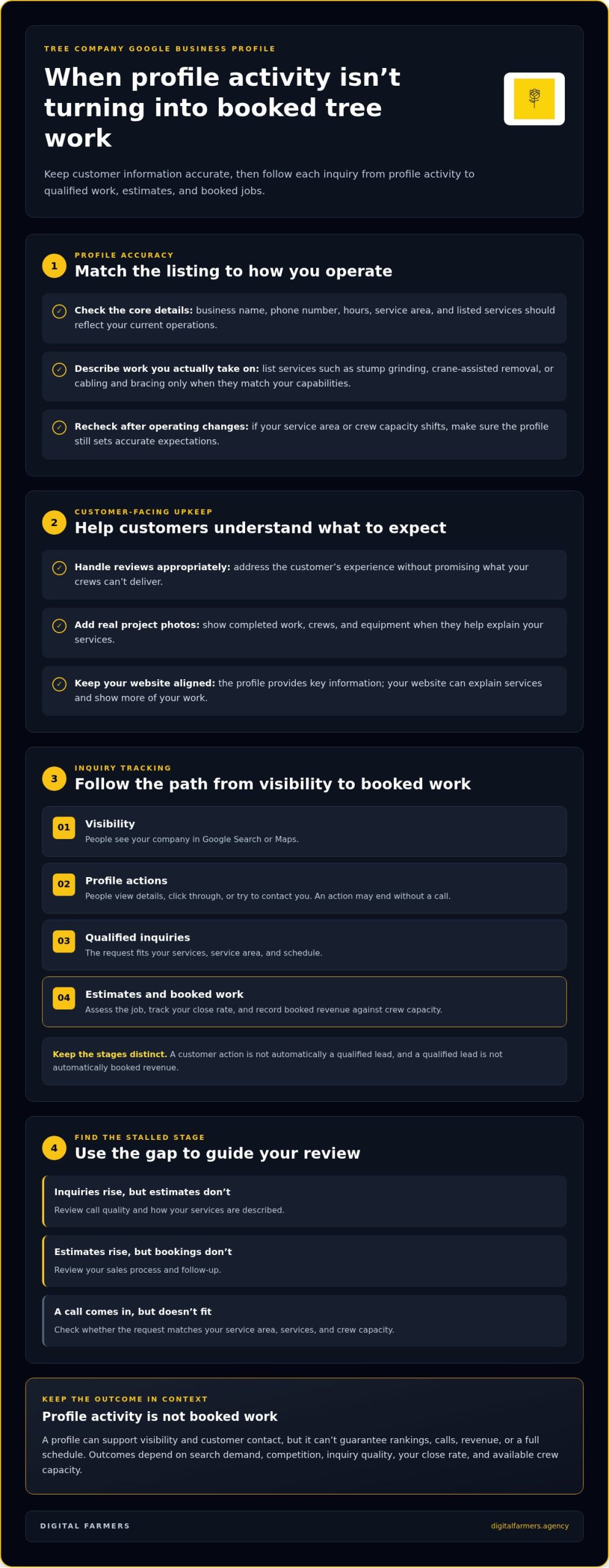
Start with the details a potential customer uses to decide whether to call: your business name, phone number, hours, service area, and services. Make sure they reflect how your company operates. If you offer stump grinding or crane-assisted removal, describe those services accurately. Don’t imply coverage or availability your crews can’t support.
Customer-facing upkeep also includes responding to reviews appropriately and adding useful photos of real jobs, crews, and equipment. These details help set expectations before a customer calls. A photo of a completed removal, for example, gives more context than a generic image that could belong to any contractor.
Keep your profile and website aligned. The profile gives customers a quick way to find key information, while your website can explain services and show more of your work. Tree service SEO covers wider visibility work, and paid advertising uses a separate budget and campaign structure. These channels can support each other, but managing them is not the same as updating profile details.
Which business outcomes matter beyond profile activity
Profile views and actions show that people interacted with your listing. They don’t tell you whether a caller is inside your service area, needs work you perform, or can schedule within your current capacity. A click can end without a call. A call may be outside your service area or a poor fit for your crews.
Follow the business path instead of stopping at the profile dashboard:
- Visibility: People see your company in Search or Maps.
- Profile actions: They view details, click through, or try to contact you.
- Qualified inquiries: The request fits your services, service area, and schedule.
- Estimates and booked work: You assess the job, track your close rate, and record booked revenue against crew capacity.
Compare these stages over time. If inquiries rise but estimates don’t, review call quality and how your services are described. If estimates rise but bookings don’t, look at the sales process and follow-up. Profile activity alone won’t show you where the problem sits. For a broader approach to connecting search visibility, advertising, and follow-up, see this tree company lead generation strategy.
Profile engagement shows that someone interacted with your listing; a booked job shows that an inquiry became scheduled work. Profile management can support visibility and customer contact, but it can’t guarantee rankings, calls, revenue, or a full schedule. Those outcomes depend on search demand, competition, inquiry quality, your close rate, and available crew capacity.
What Tree Company Google Business Profile Management Should Include
Profile management should leave you with accurate customer information, clear ownership of recurring tasks, and reporting you can connect to calls and estimates. “Optimization” by itself isn’t a work plan. For a tree company Google Business Profile, the work needs to reflect the jobs you perform and the calls your office can handle.
Keep profile information aligned with real operations
Set a routine to review the business details customers use before contacting you. Check that the phone number, hours, service area, and listed services match current operations. Name work you actually take on, such as stump grinding or cabling and bracing, rather than using broad descriptions that could attract requests outside your capabilities.
Tie profile changes to operating decisions. If your service area or crew capacity shifts, review whether the profile still sets accurate expectations. Make sure inquiries reach the right person and that someone records the request, source, job type, and next step. A profile can prompt contact, but it can’t answer a missed call or qualify a job for you.
Review customer feedback and respond in a way that addresses the customer’s experience without making promises your crews can’t keep. Add photos of completed work, equipment, and crews when they help explain what customers can expect. Use real project images and descriptions that reflect your work, not stock visuals or unsupported claims.
Google can change profile tools, labels, and policies. Before making an edit that depends on a particular feature or rule, review Google’s current guidance. This can help you avoid turning a routine maintenance task into an avoidable profile problem.
Connect profile activity to reporting and follow-up
Profile data is only one part of the record. Where current reporting makes the data available, track customer actions alongside calls, form inquiries, estimates, and booked jobs. Use a consistent method to identify where each inquiry came from, then record whether it matched your services and service area and whether it advanced to an estimate.
Keep the stages distinct. A customer action is not automatically a qualified lead, and a qualified lead is not automatically booked revenue. Reporting should show where inquiries stall, whether your close rate changes, and whether the work you win fits crew capacity and backlog.
Profile activity needs business context: a click matters only when you can see what happened to the inquiry after it reached your company. Check the reporting interface before relying on specific profile metrics, since availability and labels can change. Focus on the information that helps you make decisions, not a bigger dashboard for its own sake.
Profile maintenance has clear boundaries. Local SEO addresses broader visibility across Maps and your website. Google Ads and Local Services Ads are paid channels with separate campaign management, while CRM work supports inquiry follow-up and pipeline records. These services can be coordinated, but they aren’t profile edits. Learn how Digital Farmers supports tree service marketing.
Compare Profile Management Options by Ownership and Accountability
You may be updating the profile between calls, asking an employee to handle it, or already working with a marketing provider. The right setup depends on who has the skills, who has time, and what work is already underway. For a tree company Google Business Profile, clear responsibility matters as much as the task list.
Compare responsibilities, access, and reporting
Use this comparison to assign the work before changing who manages it. Responsibilities can overlap, especially when an in-house marketer and an agency share tasks. Make sure someone owns each task and your company retains direct access to its business assets.
| Management setup | Responsibility | Account control | Reporting | Owner time |
|---|---|---|---|---|
| Owner-managed | You handle profile details, customer-facing updates, and review responses. | You control the profile and related accounts. | You connect activity to inquiries using your own records. | Recurring work stays with you or your staff. |
| In-house-supported | An employee handles assigned updates, with you setting priorities and checking accuracy. | Your company retains control; access follows assigned duties. | Your team can combine profile activity with call and job records. | You spend time directing, reviewing, and filling gaps. |
| Agency-managed | The agency handles agreed profile work, while your team supplies operational updates and responds to leads. | Your company should retain ownership and direct access. | Agree on reporting that separates profile actions from qualified inquiries and booked work. | You provide input and review performance rather than managing every update. |
Keep control of your profile and related assets
Ownership should remain with your company, even when someone else handles day-to-day work. That includes your GBP, domain, website, ad accounts, tracking, CRM, customer data, and customer list. Direct access helps prevent a change in responsibilities from becoming a scramble to recover logins, records, or campaign history.
Digital Farmers keeps those assets with the client. The agency audits existing work before recommending changes and can work alongside an in-house marketer. A useful review identifies what is functioning, what is unclear, and what needs attention. Replacing everything by default can waste useful history and disrupt work that is already producing qualified inquiries.
Choose a setup that fits your capacity
Owner-managed work can suit a company with a clear process and time to maintain it. In-house support can work when a staff member has the skills and access to keep information current. Agency management can take recurring profile work off your plate, but it still needs operational input from you.
Digital Farmers’ model requires roughly two hours per month of owner involvement. That time supports coordination and decisions, not a handover of every marketing responsibility. Before changing the arrangement, define who updates business details, who reviews reporting, and who follows up on inquiries. Keep the parts of your existing marketing that work and assign the remaining gaps clearly.
Measure Whether Profile Management Supports Qualified Tree-Service Work
Your profile activity may rise while estimates and booked jobs stay flat. Before changing the tree company Google Business Profile, establish what it contributes and where inquiries go after the first interaction. A sound review follows the work through your phone and sales process, not just the profile dashboard.
Set a useful baseline before changing profile work
Start by recording the current state. Note the profile information, available activity data, how calls and form inquiries are captured, and who follows up. Include existing Local SEO, advertising, website, and referral work so you can see what is already producing inquiries before making changes.
Then track the path from interaction to outcome. Keep profile views and other available actions separate from calls, qualified leads, estimates, and booked work. For each inquiry, record the service requested, whether it fits your service area, whether you gave an estimate, and whether the job was booked. That record helps show where opportunities are being lost.
Use a consistent review period, but don’t assume platform data will always cover the same span or appear under the same labels. Available data and reporting periods can vary. Compare like with like, and don’t treat one change or an unusually busy stretch as proof that profile management caused a result.
Assess fit before adjusting
Interpret the numbers against the operation behind them. A rise in calls can mean little if they’re outside your service area or for work you don’t perform. More qualified inquiries may still produce fewer booked jobs if your close rate shifts, estimates are delayed, or crews have limited availability.
Service mix and seasonality matter, too. Demand for storm response can affect call volume differently from planned pruning or plant health care. Review inquiry type, estimate rate, close rate, booked revenue, backlog, and available crew capacity together. Then adjust the part of the process the evidence points to, whether that means clarifying service information, improving follow-up, or reviewing another marketing channel.
Use case studies as examples, not forecasts
Named results show what happened in a specific business, but they don’t establish what another company should expect. After GBP recovery and a site rebuild, Technical Tree Service’s revenue grew from $1M to $2.1M. Burnett Land and Tree generated 131 leads and 50+ calls shortly after profile verification.
Those outcomes belong to Technical Tree Service and Burnett Land and Tree. They aren’t forecasts for your company. Your results depend on market demand, competition, service mix, inquiry handling, close rate, and crew capacity. Use case studies as context, then judge your own profile against your own baseline and booked work.
Digital Farmers explains its market review process for assessing your profile and inquiry tracking against county-level search demand.
Decide Whether Digital Farmers Fits Your Tree Company Profile Needs
You may need profile work handled consistently, but that doesn’t mean every part of your marketing needs replacing. Digital Farmers manages Google Business Profile and Google Maps as part of a coordinated customer-acquisition system for tree service companies. The right scope depends on what your current marketing is doing and where the gaps are.
Review the operating model before making changes
Digital Farmers audits existing marketing work before recommending changes. That gives you a view of what is functioning, what needs attention, and how profile management could fit alongside your current staff or vendors. The goal is a clear division of work, not a forced reset.
Your company retains ownership of the GBP, domain, website, ad accounts, tracking, CRM, customer data, and customer list. Direct access matters if responsibilities change. It keeps business records and marketing assets with your company rather than tying them to a provider relationship.
Profile management can sit alongside Local SEO, Google Ads, Local Services Ads, website work, and CRM reporting. These are related parts of a customer-acquisition system, but each has a distinct role. Direct mail is optional, not a standard component of every plan.
Digital Farmers does not mark up ad spend. You pay Google directly for the advertising budget, keeping media costs separate from management work. That separation makes it easier to see where the budget goes.
Digital Farmers works with one client per county under contractual exclusivity. That defines how the company works with tree service businesses in a county, but it doesn’t mean every market or operation is automatically a fit. The work still needs to match your service area, search demand, crew capacity, and business goals.
Use the market review to assess county-level fit
A market review gives you a practical basis for deciding what to do next. It covers search demand in your county, which companies are ranking, and what your profile and website are producing. That context helps distinguish a profile issue from a wider gap in local search visibility or inquiry handling.
Bring the review back to operating realities. Consider whether inquiries fit your services, whether your team can follow up, and whether booked work aligns with crew availability and backlog. A review can inform those decisions, but it can’t promise rankings, lead volume, or revenue. Those outcomes depend on market conditions and how well the full system supports customer contact and conversion.
If profile management is the main gap, the review can help define its responsibilities. If the issue sits elsewhere, it can show where your website, advertising, or follow-up process needs attention. Either way, you get a clearer basis for deciding whether to adjust current work or coordinate additional support.
Call Digital Farmers for a market review for your county. The review covers search demand, who is ranking, and your current profile and site performance. Call +1 (603) 802-6879.
Make Your Next Profile Decision With Clear Evidence
Your next move doesn’t need to be a full marketing reset. Treat your tree company Google Business Profile as one part of the work pipeline, then decide whether its current setup fits the calls you want, the jobs you can take, and the crews you can schedule. A measured adjustment beats a broad change without a clear reason.
Digital Farmers works with tree service, crane service, and land-clearing companies in the United States. A county market review gives you a decision point before anything changes. You’ll see search demand, who is ranking, and what your profile and site are producing right now. It informs your next step, without promising rankings or lead volume.
Learn about Digital Farmers and how its marketing services fit into your customer-acquisition system.
Frequently Asked Questions
What does Google Business Profile management include for a tree company?
It covers routine checks that keep customer-facing details useful as your operation changes. For a tree company Google Business Profile, that can mean reviewing seasonal hours, confirming service descriptions still match the jobs you accept, and checking that the right person handles profile inquiries. Set a recurring review point so these tasks don’t get lost during busy stretches or crew changes.
Can an agency manage a tree company Google Business Profile without owning it?
Yes. Management access and ownership are separate. Your company can retain authority over the profile while an agency handles agreed tasks. Document who can make routine edits, who approves significant changes, and how access will be adjusted if responsibilities change. That gives your team a clear process without tying profile control to one person’s availability.
How much time does a tree company owner need to spend on profile management?
The time depends on what you delegate and how often your operation changes. With managed support from Digital Farmers, your role is mainly to provide accurate updates about service availability, crew capacity, and customer handling. The model requires roughly two hours per month of owner involvement. A regular check-in and a clear route for urgent corrections help keep information aligned with current operations.
Does a managed Google Business Profile guarantee more tree service calls?
No. Management can support accurate information and a clearer customer path, but it can’t guarantee call volume. Search demand, competition, service fit, and your follow-up all affect the outcome. Track whether callers are in your service area, request work you perform, and move to an estimate. That gives you a better basis for judging performance than profile activity alone.
Can Digital Farmers work with an in-house marketer or existing vendor?
Yes. Work can be divided by task rather than forcing one person or provider to handle every channel. Agree on who maintains profile details, who coordinates website changes, and who shares inquiry outcomes for reporting. A simple responsibility map reduces duplicate edits and missed handoffs. Digital Farmers audits current work before recommending changes, so existing efforts can stay in place when they’re serving the company.
Who pays Google for ad spend when Digital Farmers manages marketing?
You pay Google directly for ad spend, with no markup from Digital Farmers. Keep those charges separate from management costs so you can see media spend alongside calls, qualified inquiries, and booked work. Your company retains ownership of its ad accounts and campaign assets.
What happens during a market review for a tree company’s county?
The review looks at search demand in your county, which companies are ranking, and what your profile and website are producing. It gives you a basis for deciding whether profile work, website changes, or another part of marketing needs attention. Compare visibility with the types of jobs your crews can take on. The review informs decisions, but it doesn’t predict rankings or lead volume.
Book a market review for your county. You see search demand, who is ranking, and what your profile and site are producing right now, before anything changes. Call +1 (603) 802-6879.