

Your phone can swing from quiet to nonstop while the estimate calendar still has gaps. A tree company lead generation strategy should bring in qualified calls that fit your service area and crew capacity, not just more clicks.
Search visibility, paid ads, and follow-up each do a different job. When they operate separately, you may pay for inquiries that never become estimates, miss calls while crews are on-site, or book work that does not fit your equipment or schedule. More marketing activity alone will not fix those gaps.
This article explains how to connect search demand, your Google Business Profile, advertising, and follow-up. You’ll learn to assess calls by location and job fit, track inquiries through estimates and close rate, and measure booked work rather than clicks alone. The goal is a steadier pipeline from multiple sources, matched to the crew capacity you actually have.
Keep your review routine simple enough to maintain during busy weeks. Assign someone to record inquiry outcomes and choose a regular time to review the results. Note each change and why you made it, so you can judge its effect using your records instead of memory.
Table of Contents
- A tree company lead generation strategy starts with the work you need to book
- How search, advertising, and follow-up work together
- Choose a channel mix based on lead quality, capacity, and ownership
- Build a practical lead generation plan and measure what changes
- How Digital Farmers supports an owned lead generation system
A tree company lead generation strategy starts with the work you need to book
Your phone can go quiet between busy stretches, but payroll, equipment, and crew schedules keep moving. Calls alone do not make the week predictable. You need to know whether inquiries match the work your crews can perform and whether those inquiries turn into booked jobs.
Lead generation is how you attract potential customers, capture their inquiries, and follow up when they are a fit. For a tree company, that process has to account for service area, job requirements, and available capacity. A call is the start of the process, not proof that suitable work is coming.
Definition: A tree company lead generation strategy coordinates how you attract, capture, qualify, and follow up on inquiries. It also tracks whether those inquiries become estimates and booked work that fits your crews.
Separate lead volume from work your crews can perform
A high inquiry count can hide a poor fit. A caller may be outside your service area, need work you do not handle, or want a job that requires equipment or crew availability you do not have. Those calls still take time, but they may not lead to a workable estimate.
Consider three different requests: storm damage cleanup that needs prompt scheduling, stump grinding that fits a crew already set up for that work, and land clearing that calls for a different scope and equipment plan. Assess each inquiry on its own terms. A larger number of calls does not automatically mean more suitable estimates or booked jobs.
A qualified lead is an inquiry for work your company performs, within your service area, that you can assess and schedule with your available crew capacity. Use this definition to filter inquiries before judging a marketing source by lead count.
Set the business outcome before choosing channels
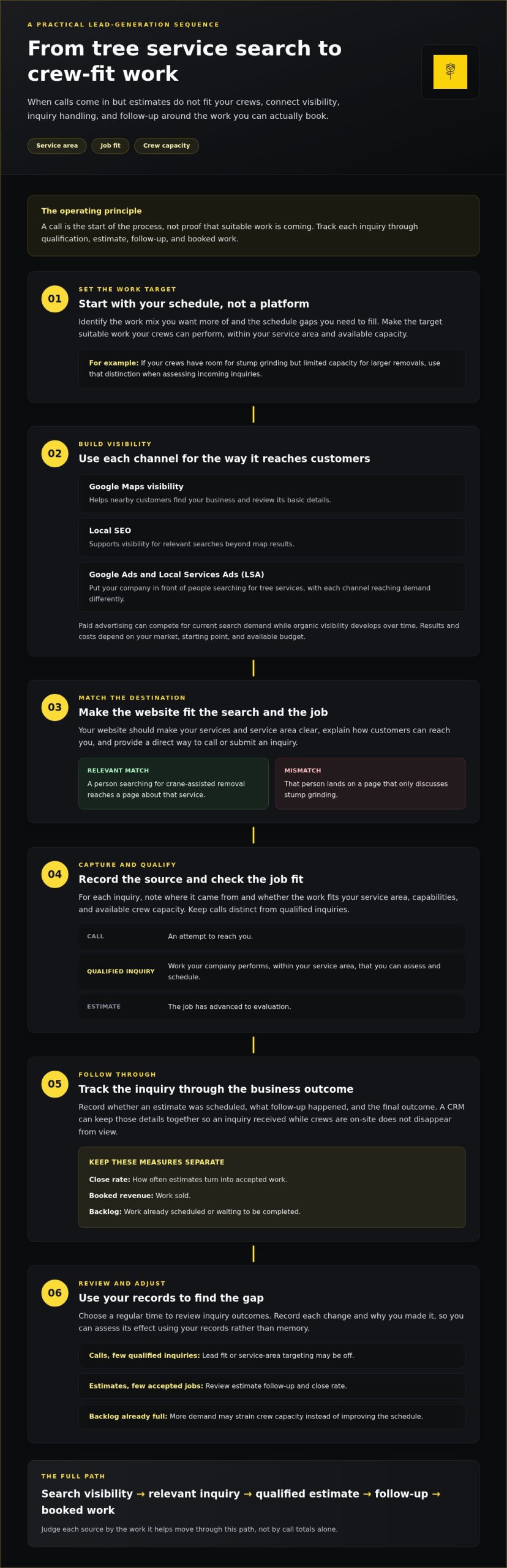
Start with your schedule, not a platform. Identify the work mix you want more of and the gaps you need to fill. If your crews have room for stump grinding but limited capacity for larger removals, use that distinction to assess incoming inquiries and prioritize follow-up.
Keep each pipeline stage distinct. Calls are attempts to reach you. Qualified inquiries fit your services and operating limits. Estimates mean a job has advanced to evaluation. Close rate measures how often estimates turn into accepted work. Booked revenue records work sold, while backlog shows what is already scheduled or waiting to be completed.
These measures help you find where the process is breaking down. If calls come in but few qualify, your lead fit or service-area targeting may be off. If qualified inquiries receive estimates but do not become accepted work, review estimate follow-up and close rate. If your backlog is already full, more demand may strain crew capacity instead of improving the schedule.
Use a tree company lead generation strategy to pursue a business outcome you can name, such as filling open schedule slots with suitable work. Assess channels by how they contribute to that outcome, not by activity alone. For more on balancing demand with available capacity, see how to keep tree service crews booked without overloading the schedule.
How search, advertising, and follow-up work together
A caller may find your company in Google Maps, click an ad, or reach your website through an organic search. Each path can create an inquiry, but none books the work on its own. Your tree company lead generation strategy needs to connect visibility to a clear next step and record what happens after the phone rings.
Google Maps visibility helps nearby customers find your business and review its basic details. Local SEO supports visibility for relevant searches beyond map results. Google Ads can put your company in front of people searching for tree services, while Local Services Ads (LSA) can generate calls from customers using that format. Each channel reaches demand differently, and performance depends on your market and setup.
Your website supports those channels. It should make your services and service area clear, explain how customers can reach you, and give them a direct way to call or submit an inquiry. If someone searching for crane-assisted removal lands on a page that only discusses stump grinding, the mismatch can cost you a suitable call.
Use faster and longer-term channels for different needs
Paid advertising can put your company in front of active search demand while organic visibility develops over time. That does not make one channel right for every schedule. A company with established visibility and available crew capacity faces different conditions from one starting with little search presence or limited room for new work.
Timing and cost depend on the market, your starting point, and the budget available. Treat paid channels as a way to compete for current demand, not as a promise of a certain number of calls. Treat SEO as ongoing work, not a fixed-date delivery of rankings or leads.
Connect every inquiry to its next business step
Give each inquiry a clear path: record its source, check whether the job fits your service area and capabilities, note whether an estimate was scheduled, then track follow-up and the final outcome. A CRM can keep these details together, so a call received while crews are out does not disappear from view.
Marketing creates opportunities to talk with potential customers. Your call handling, estimating, follow-up, close rate, and crew scheduling determine what happens next. Keep those responsibilities distinct, but measure them together so you can see where a promising inquiry stalled.
Tracking calls through booked work shows which sources contribute to estimates and accepted jobs, not just which sources make the phone ring. For example, if one source brings inquiries that rarely fit your service area while another produces estimates that become scheduled work, that difference matters more than raw call totals.
A coordinated system can keep your website, customer information, and channel records under your control. Digital Farmers’ lead generation services coordinate channels and customer-acquisition assets for tree service companies.
Choose a channel mix based on lead quality, capacity, and ownership
A full estimate calendar changes the value of another call. If crews are booked out, more inquiries can add pressure without creating useful work. If the schedule has gaps, a channel that brings suitable jobs into your service area may help, provided you can answer and follow up.
Choose channels around the work you can take on, not a target for raw lead volume. A tree company lead generation strategy should account for job type, location, crew availability, and what happens to customer information after an inquiry.
| Channel | Purpose and likely role | Measure | Operational dependency |
|---|---|---|---|
| Google Maps and GBP | Help nearby customers find and evaluate your business. | Relevant calls and qualified inquiries. | Accurate services, service area, and profile information. |
| Local SEO | Build visibility for service-related searches over time. | Qualified inquiries and estimates attributed to organic search. | Useful service information and ongoing work. |
| Google Ads and LSA | Reach people actively searching for tree work. | Qualified calls, estimates, and booked jobs by source. | Available budget, call handling, and capacity for the work promoted. |
| Website | Explain services and make it straightforward to contact you. | Calls and inquiries that become estimates. | Clear service details and working contact paths. |
| Direct mail | Reach selected households outside search channels. | Responses and booked work tied to the campaign. | A relevant audience, a clear offer, and a way to record responses. |
Match channels to service demand and available crews
Match each channel to the gap you need to fill. If you want more stump grinding and have a crew with room for that work, make sure the promoted services and targeted areas fit that capacity. If land clearing already fills the schedule, adding demand for the same work may extend the backlog without helping the operation.
Channel choice also depends on how people search in your market, the visibility you already have, and the budget available. A paid advertising comparison can help you understand the options, but the right mix still depends on whether your crews can take the work and your office can handle the calls.
Keep control of the assets behind your marketing
Owned customer-acquisition assets are the accounts and records your company retains, rather than access to another company’s audience. Control of your website, Google Business Profile, ad accounts, tracking, CRM, and customer data lets you review performance and retain useful records if a vendor changes.
Direct mail is optional, not a standard part of every plan. Coordinated channel management can also run alongside an existing vendor or in-house marketer. Effective work does not need to be replaced by default.
Assess each channel against your schedule, service area, and ability to handle inquiries. Keep the mix focused on work your crews can perform and measure.
Build a practical lead generation plan and measure what changes
Marketing changes without a clear baseline can disrupt work that is already bringing in suitable jobs. Before you replace a channel or change vendors, find out where calls come from, which inquiries fit your operation, and where good prospects stop moving toward booked work.
A practical tree company lead generation strategy uses a repeatable review process. Keep the steps simple enough to maintain while you are running crews and answering the phone.
- Audit current sources. Record whether each inquiry came from Google Maps, Local SEO, Google Ads, LSA, referrals, or another source. Note whether the caller is within your service area and needs work your company performs.
- Set service priorities. Identify the job types you want to book and the schedule gaps you need to address. Check those priorities against crew availability, equipment, and current backlog.
- Track inquiry stages. For each source, record calls, qualified inquiries, estimates, accepted work, and follow-up. Keep the stages separate so a high call count does not hide weak estimate activity.
- Review outcomes. Compare qualified calls, estimates, close rate, booked work, backlog, and crew capacity over time. Look for patterns by channel and job type, not just a single busy week.
- Adjust one gap at a time. Preserve marketing work that produces suitable inquiries and booked jobs. Change a specific problem, such as unclear service information, missed follow-up, or inquiries outside your coverage, then review the effect.
Audit calls and estimates before changing the system
Start with the records you already have. If you cannot identify where calls originated, improve source tracking before deciding which channel to cut. If callers routinely ask for work outside your service area, address targeting or service-area information before adding more activity.
Use the same measures at each review. Qualified calls show whether inquiries fit; estimates show whether they advance; close rate shows how often estimates become accepted work. Backlog and crew capacity show whether you can handle booked demand. These records can also help you plan consistent tree removal lead generation around the work your crews can take.
Use evidence without treating one case as a forecast
Results depend on competition, starting visibility, local service demand, and follow-up. A case from another company shows what happened under its conditions. It does not establish what your company will receive.
Digital Farmers built Burnett Land and Tree’s website and Google Business Profile from scratch. The profile began ranking within about two weeks of verification, and the case records 131 leads and more than 50 calls for Burnett Land and Tree. Those results belong to that company and are not a forecast for your market.
Use your own records to decide what to preserve and what to address. A market review can help identify channel gaps and measurement needs before you change working parts of the system. More information about Digital Farmers’ tree service lead generation support is available on the company website.
How Digital Farmers supports an owned lead generation system
You do not need another disconnected marketing task. You need channels, customer records, and follow-up that support the work your crews can take on. Digital Farmers coordinates Google Maps optimization, Local SEO, Google Ads, and LSA for tree service companies, based on local search demand and business priorities.
The starting point is what is already in place. Existing marketing work is audited before replacement is considered, so you can identify what is producing qualified inquiries and where the gaps are. The right plan depends on your service area, competition, current visibility, available crew capacity, and how inquiries are handled.
Keep the system aligned with your existing operation
Marketing support can run alongside an in-house marketer or existing vendor. Your team can keep handling estimates, customer calls, and scheduling while channel work is coordinated with the realities of your operation. Owner involvement is roughly two hours per month, with actual needs depending on the company and the decisions involved.
Digital Farmers uses a one-client-per-county exclusivity model as a contractual arrangement. It defines how the relationship is structured. It is not a claim about rankings, call volume, or booked work.
Ownership matters, too. Clients retain their domain, website, Google Business Profile, ad accounts, tracking, creative assets, data, CRM, and customer list. That keeps your acquisition records and customer relationships with your business rather than tying them to a rented audience.
Digital Farmers does not mark up ad spend. Clients pay Google directly. Direct mail is optional, not a standard part of every plan.
Use the market review to decide on a next step
A county market review examines search demand, current rankings, Google Business Profile visibility, and website performance. It gives you a starting point for judging whether your current channel mix fits your services, service area, and crew capacity. The review helps identify what is working and what may need attention before changes are made.
Digital Farmers’ tree service lead generation support coordinates channel management around your existing operation. A market review can help you decide whether you need more visibility, clearer tracking, stronger follow-up, or no major change right now.
Book a market review for your county. You see search demand, who is ranking, and what your profile and site are producing right now, before anything changes. Call +1 (603) 802-6879.
Set the next step around your county and crew capacity
A steadier pipeline starts with a clear baseline, not another round of changes made on instinct. Use what you know about the work your crews can take, then assess whether search demand and current visibility support that plan. A tree company lead generation strategy should fit your service area and schedule, not chase calls your operation cannot use.
Digital Farmers has been a Tree Care Industry Association member since 2025. A market review gives you a view of county search demand, who is ranking, and what your profile and website are producing before anything changes. Use that information to decide what to keep, what needs attention, and whether a different channel mix fits.
The company website describes Digital Farmers’ lead generation services for tree service companies. Your next step is to review your county’s search demand, current visibility, and the work your crews can handle.
Frequently Asked Questions
How can a tree service company get more qualified leads?
Make it easy for the right customers to recognize that your company handles their type of work. Describe services clearly, state the areas you serve, and give callers a direct way to reach you. During intake, record the job type, location, and requested timing. Review those details against the estimates you want to write, then improve the information that attracts poor-fit inquiries.
What is the best lead generation strategy for a tree company?
The right strategy depends on your service mix, market, current visibility, and crew availability. A company building visibility from a weak starting point may need different work from one that already receives steady inquiries but struggles to convert estimates. Judge your tree company lead generation strategy by whether suitable inquiries progress to accepted work your crews can schedule, not by call volume alone.
Should a tree company use Google Ads or Local SEO first?
Use Google Ads when you need to compete for active search demand and have the budget and capacity to handle the inquiries. Build Local SEO when you can invest in visibility that develops over time. The order depends on your market, starting visibility, and schedule. If the calendar has open slots now, paid demand may address a different need than longer-term organic work.
How do tree service companies track which marketing channels produce booked jobs?
Give each inquiry a source in your call log or CRM, then update its status as it moves from first contact to estimate, accepted job, or lost opportunity. Record job type and service area, too. At review, compare sources by estimates and booked jobs, not just calls. That helps you distinguish a channel that attracts attention from one that contributes work your crews can schedule.
Can a tree service company manage marketing while crews are busy?
Yes, if someone owns the basic intake and review process while you are in the field. Assign a team member to capture caller details and update inquiry status, then set a regular time to review estimates and follow-up. Keep the process short and consistent. If no one can answer or record calls during busy periods, adding more promotion may increase missed opportunities rather than improve booked work.
Are shared lead platforms the same as owning your marketing assets?
No. A shared lead platform gives you access to inquiries distributed through its system. An owned marketing setup builds visibility and customer records tied to your company, giving you more control over how those assets are managed. The practical difference is continuity: you retain your marketing history and customer relationships instead of relying only on access to a third party’s inquiry flow.
What should a tree company do when calls increase but estimates do not?
Find where callers drop out before changing your advertising. Review whether calls are answered, whether callers fit your service area and work types, and whether the next step toward an estimate is clear. Check how quickly your team follows up on missed contacts and pending requests. If calls are qualified but estimates remain low, examine intake and estimate scheduling before increasing demand.
Book a market review for your county. You see search demand, who is ranking, and what your profile and site are producing right now, before anything changes. Call +1 (603) 802-6879.