

You may have a spreadsheet full of tree service keywords, but that list won’t help if it mixes jobs your crews perform with searches they can’t serve. Phrases for emergency tree removal, stump grinding, pruning, and general tree-care questions all signal different needs. The useful work is deciding which searches fit your services and where each group belongs.
Search volume alone won’t tell you whether a phrase can turn into a qualified call. A high-volume term may attract people outside your service area or requests that don’t fit your crew capacity. A smaller group of searches may be more valuable if it matches the jobs you want to book.
This guide shows you how to sort searches by service, customer need, urgency, and intent, then match each group to a page with one clear purpose. You’ll build a practical keyword map for service pages and educational content, and prioritize work your operation can handle. The goal is a plan tied to real jobs, not a spreadsheet full of phrases.
Key Takeaways
- Sort tree service keywords by the work, problem, urgency, and customer need behind each search.
- Separate searches for hiring, estimates, and tree-care information so each group has a clear page purpose.
- Use a keyword map to connect service searches to focused website pages and educational searches to useful articles.
- Review service fit, intent, search evidence, and crew capacity before deciding which keyword groups deserve attention.
- Use keyword research to guide website, local SEO, GBP, and campaign decisions, starting with an audit of existing work.
What tree service keywords tell you about a customer’s job
Your keyword list may include requests for removals, questions about unhealthy trees, and searches for pruning advice. Those phrases point to different needs. A tree service keyword is a search phrase that signals a job, a problem, a need for a provider, or a question someone wants answered.
That signal matters more than the size of the list. A phrase is useful to your business when it connects to work you perform, customers you serve, and jobs you can schedule. A large list can look productive while directing your website plan toward searches unlikely to become relevant inquiries.
How customer searches describe tree work
Some searches name a service directly: “tree removal,” “tree pruning,” “stump grinding,” or “storm-damage cleanup.” These are service searches. They give you a clear starting point for identifying the work a customer may need.
Other searches describe a problem, such as “tree branches hanging over roof” or “why are my tree leaves turning brown.” The first may lead to a request for an assessment or removal. The second may come from someone looking for information rather than a crew. Understanding keyword research starts with recognizing that different phrases can reflect different search intent.
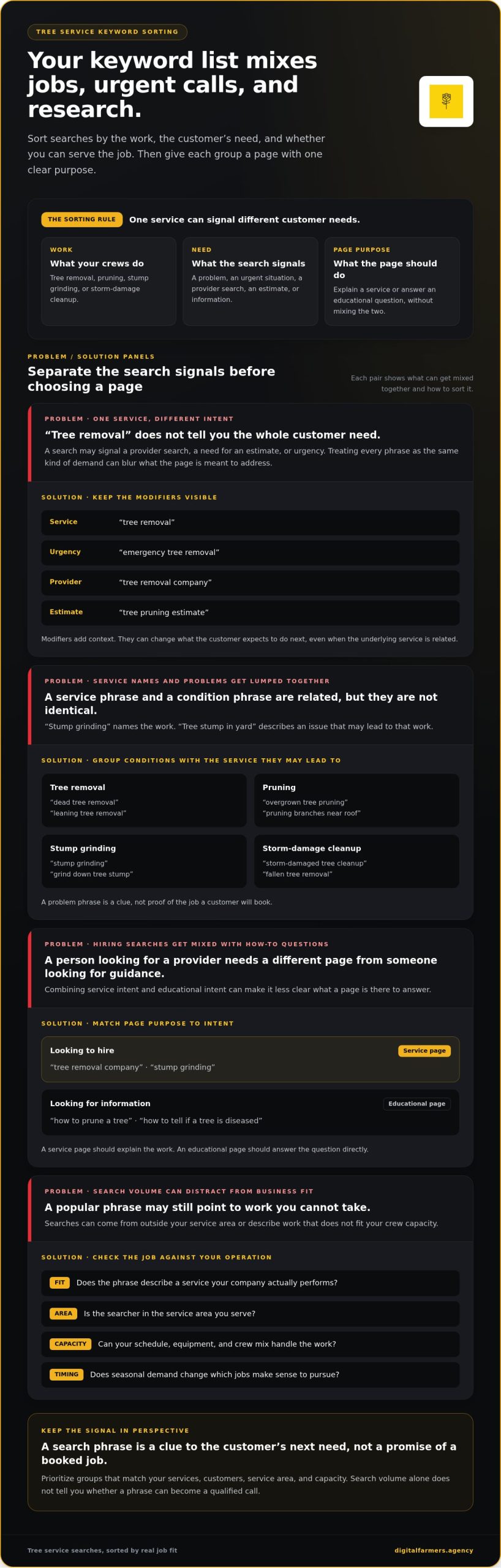
Modifiers add context. “Emergency” signals urgency. “Estimate” suggests the customer is considering a job’s scope or cost. “Company” points toward finding a provider. The core service may be the same, but the customer’s expected next step can differ.
- Service: “stump grinding” names the work.
- Problem: “tree stump in yard” describes the issue.
- Urgency: “emergency tree removal” signals a time-sensitive need.
- Provider: “tree removal company” points toward hiring.
- Estimate: “tree pruning estimate” suggests a request to discuss scope or cost.
A search phrase is a clue to the customer’s next need, not a promise of a booked job.
Why business context matters
Match each phrase to your actual service mix. If you perform crane-assisted removal, stump grinding, and pruning, those searches may support relevant pages and inquiries. If a phrase points to work you don’t perform, targeting it can attract calls your team can’t take.
Searches for a tree removal company and questions about tree health also need different treatment. The first suggests someone looking for a provider. A question about tree health or pruning techniques may call for clear educational information, especially if the searcher is still trying to understand the problem. Treating both as the same kind of demand can make your pages less useful.
Capacity matters, too. A service may fit your company but not your current schedule, equipment, crew mix, or service area. Seasonal demand can also change which jobs make sense to pursue. Prioritize phrases that connect customer need to work you can handle instead of chasing every search that mentions a tree.
How to group tree service keywords by work, urgency, and intent
A single service can appear in searches from customers at different stages. Someone searching “tree removal” may be comparing providers, while someone searching “how to remove a tree stump” may be looking for instructions. Grouping tree service keywords by both the work and the reason behind the search keeps those needs separate.
Start with practical categories: service, problem, urgency, provider, estimate, and education. Categories can overlap. “Emergency tree removal company” names a service, signals urgency, and shows provider intent. That combination gives you more context than the service term alone.
Service and problem-based keyword groups
Start with the work your crews perform. Create a group for each service, then add the words customers use to describe the conditions that may lead to that work. The tree care industry overview provides context on the range of tree-care activities, but your keyword groups should reflect your own work mix.
- Tree removal: “tree removal,” “dead tree removal,” or “leaning tree removal.”
- Pruning: “tree pruning,” “overgrown tree pruning,” or “pruning branches near roof.”
- Stump grinding: “stump grinding” or “grind down tree stump.”
- Storm-damage cleanup: “storm-damaged tree cleanup” or “fallen tree removal.”
Keep the service and problem connected, but don’t assume every problem phrase signals the same job. “Dead tree” may lead to a removal request. “Tree leaves turning brown” may come from someone seeking information about tree health. The phrase helps you sort intent, but it doesn’t prove what the customer will book.
Urgency, estimate, and educational keyword groups
Next, add modifiers that show what a customer may need. “Emergency,” “storm damage,” and “fallen tree” point to urgency or a specific event. “Estimate,” “cost,” and “company” suggest someone evaluating scope, price, or providers. One service can appear in several intent groups, even when the work itself stays the same.
Keep informational searches separate. “How to prune a tree” and “how to tell if a tree is diseased” ask for guidance. A service page should explain the work and make the next step clear. An educational page should answer the question directly without treating every reader as ready to schedule a crew.
Service searches point toward hired work; informational tree-care queries point toward answers. Choose a page purpose before combining phrases. To connect these groups to a practical marketing plan, review keyword research for your tree company.
How to map tree service keywords to pages without overlap
A keyword map gives each page a clear job. If your tree removal page, homepage, and blog article all target the same hiring search, customers and search engines get no clear signal about which page best answers the need. Assign each query group to the page that matches the customer’s intent.
Use this as a working map. Adapt the examples to the services you perform and the way your customers describe them.
| Query group | Likely intent | Suitable page type | Example phrase |
|---|---|---|---|
| Tree removal service | Find a provider for removal work | Tree removal service page | “tree removal company” |
| Pruning service | Hire a crew for pruning | Tree pruning service page | “tree pruning estimate” |
| Stump grinding | Arrange stump work | Stump grinding service page | “stump grinding service” |
| Storm damage | Find help with a storm-related tree problem | Relevant cleanup or removal page | “fallen tree removal” |
| Tree health question | Understand a condition or possible cause | Educational article | “how to tell if a tree is diseased” |
Which keyword groups belong on service pages?
Build a service page around the work itself. A tree removal page can cover close variations such as dead tree removal, leaning tree removal, and tree removal estimates, as long as the page answers the shared need: finding information about hiring for removal. Use the service name naturally in the page title, headings, and copy. Don’t create a separate page for every wording variation.
Keep distinct services separate when customers need different information. Stump grinding and pruning involve different work, so each can have its own page if you perform both. Use emergency language only if your company handles that work. A page that suggests a response you can’t provide sets the wrong expectation before the first call.
Where informational searches fit
Give genuine tree-care questions room for a full answer. An article about signs of a diseased tree can explain what a homeowner may observe and when a professional assessment may be relevant. It shouldn’t compete with a service page by acting like a removal or plant health care booking page.
Provider and estimate searches need a direct route to the matching service information. A pruning estimate search belongs with pruning, not a general tree-care article. From an educational article, link to the relevant service page when it helps the reader take a sensible next step.
Give each page one primary purpose. Close variations can share a page when they express the same need. Create separate pages when customers need different information. This keeps your tree service keywords organized around useful pages instead of scattered across competing ones.
How to prioritize tree service keywords using business fit
A keyword can show search demand and still be a poor fit for your company. It may describe work you don’t perform, attract customers outside your service area, or point to jobs your crews can’t take on right now. Prioritize tree service keywords by what they can support operationally, not by volume alone.
Search volume shows estimated interest, not how many calls you’ll receive or jobs you’ll book. Treat it as one signal. Service fit, customer intent, inquiry history, close rate, and crew capacity give you a better basis for deciding which groups deserve attention.
A practical review process for keyword groups
Review each group in order. Keep the notes simple enough to update when your services and schedule change.
- Confirm service fit. Mark whether the group describes work you perform and want to schedule. Note limits tied to your service area or operating priorities.
- Classify intent. Label the group as service-seeking, urgent, provider-seeking, estimate-related, or informational. This separates potential job inquiries from general questions.
- Review available evidence. Record search-demand estimates and the data source. Leave unknowns blank. Don’t treat an estimate as a forecast of calls or booked work.
- Assess capacity. Consider crew availability, equipment, backlog, and seasonal demand. A relevant group may be a lower priority if it points to work you can’t schedule.
This process prevents one attractive metric from making the decision for you. A high-demand group that doesn’t fit your services shouldn’t outrank a smaller, more relevant group by default. Set priorities based on the work you want, the inquiries you can handle, and what your operation can deliver.
Use business evidence to refine priorities
Search Console can show the queries already bringing people to your website when enough site data is available. Review those terms alongside the page that appeared and the visitor’s action, if you track it. A query with impressions but little engagement may need a different page, or it may not match your offer as clearly as you thought.
Compare search data with business records, too. Review inquiry notes, estimates sent, jobs booked, and close rate by service where those records are available. This can help distinguish phrases associated with qualified requests from searches that generate calls your team can’t serve.
Revisit the map when your service mix, crew availability, backlog, or customer demand changes. A service that fits now may not be the right focus when crews are committed elsewhere. Keep the map connected to current operating priorities instead of leaving it untouched after the first research pass.
Digital Farmers can audit your existing keyword work against service fit, intent, and available business evidence. Review keyword priorities around the work your crews can take on.
How Digital Farmers puts tree service keyword research to work
A keyword map matters when it guides real marketing work. Digital Farmers connects tree service searches with website pages, local SEO, Google Business Profile (GBP) work, and relevant campaigns. The plan starts with the jobs you want to book and the capacity your crews can support.
Turn the keyword map into coordinated work
Digital Farmers audits your existing marketing before recommending changes. The review covers current pages and activity, then identifies where the keyword map can clarify or strengthen what’s already in place. Existing work isn’t discarded by default.
Give each query group a clear page purpose and a practical way to review its contribution. A service group may guide a focused website page. Local SEO and GBP work can support searches that fit your services and service area. Relevant campaigns can use the same map to keep targeting aligned with the work you perform.
Review results in business terms when the data is available. Look beyond search visibility to inquiries, close rate, booked work, backlog, and crew capacity. These measures help you judge whether marketing is attracting requests that fit your operation, rather than simply generating more website traffic.
The same map can guide decisions across channels. If a group points to pruning work, the service page, GBP content, and relevant campaigns should describe that work consistently. Educational searches can support useful articles without being treated as immediate booking demand. Each channel has a defined role instead of pulling in a different direction.
Keep control of the marketing assets
Your customer-acquisition system should stay under your control. You retain ownership of your domain, website, GBP, advertising accounts, tracking, creatives, CRM, customer data, and customer list. These core business assets remain yours.
Digital Farmers can work alongside an in-house marketer or an existing vendor. The goal is to coordinate work around the keyword map and your operating priorities, not to replace useful activity without a reason. There is no markup on ad spend, and you pay Google directly.
A clear map gives you a working reference for page planning, local SEO, profile work, and campaigns. It also helps you review what’s active, what fits your crews, and where the evidence supports a change. Results depend on the market, the work performed, and how well the plan is carried out.
Put your keyword map to work
Your keyword map should change as your crews, service mix, and customer demand change. Keep it connected to the jobs you want to schedule, then use inquiry and booking data to guide adjustments. Tree service keywords are useful when they support clearer operating decisions, not just a fuller spreadsheet.
Digital Farmers has more than 10 years of digital marketing experience and has served more than 200 local service businesses. The company has been a Tree Care Industry Association member since 2025. A market review looks at search demand, who is ranking, and what your profile and site are producing before anything changes.
Frequently Asked Questions
What are examples of tree service keywords?
Examples include “tree removal estimate,” “emergency tree service,” and “stump grinding.” Use these phrases to check whether your website explains what customers need to know before calling, including the work involved and how to request an estimate. Review call notes for the language customers actually use. This can reveal useful wording a keyword tool may not suggest.
How do I find keywords for a tree service company?
Start with wording from estimate requests, call notes, and website forms. Add relevant suggestions from keyword tools, then record each phrase’s source and the date you checked it. When available, note whether the search led to a qualified inquiry or booked work. Keep personal customer details out of the research sheet.
Should every tree service keyword have its own page?
No. Before creating a page, check whether your site already covers the topic well and whether a customer would need meaningfully different information. If a new page would mostly repeat existing copy, improve the current page instead. Keep a page inventory that records each page’s purpose and owner to coordinate future edits and avoid duplicate maintenance.
Is search volume enough to choose a tree service keyword?
No. Track the source of calls and form submissions so you can compare which searches lead to qualified conversations, estimates, and booked jobs. Review inquiry quality with the person handling intake, not just visits or calls. A phrase may bring activity but still require too much time to qualify or fall outside the work your crews want.
How often should a tree service company review its keyword list?
Review the list when you add or pause a service, your crew schedule changes, or the business shifts its job priorities. Revisit it when call records show a recurring customer phrase your current materials don’t address clearly. Note the change and the reason so you can distinguish a business shift from a temporary fluctuation in a tool.
Should tree service companies target “near me” searches?
“Near me” can reflect a searcher’s preference for a nearby company. Make sure your business address, service-area details, phone number, and GBP information agree across customer-facing profiles. Describe accurately where you work. That gives prospective customers practical information without stuffing repeated wording into every page.
What is the difference between a tree service keyword and a tree care keyword?
The difference depends on the customer’s intended next step. A phrase about hiring for a job calls for clear information about your relevant work and how to make an inquiry. A broader tree-care question calls for a useful answer. Let the expected next step guide the page’s call to action and what you track as a result.
Book a market review for your county. You see search demand, who is ranking, and what your profile and site are producing right now, before anything changes. Call +1 (603) 802-6879.