

A thinner call schedule puts pressure on crew planning. But tree service leads slowing down doesn’t automatically mean demand has dried up. The drop could come from lower search visibility, a tracking problem, missed calls, or estimates that aren’t closing.
Find the weak point before raising ad spend. More budget won’t fix a disconnected phone number or missed follow-up. It can make the same problem more expensive.
Start with inbound calls, estimates sent, close rate, booked work, and crew capacity. Then check your GBP, map pack visibility, website tracking, and paid channels. Comparing these stages helps you tell a demand change from a pipeline problem and choose a next step that fits your service area and workload.
Key Takeaways
- Separate fewer inquiries from missed calls, stalled estimates, and jobs you didn’t close before changing your marketing plan.
- When tree service leads slow down, compare phone records, forms, and CRM entries to see whether reported inquiries match the calls your business received.
- Check GBP and Google Maps, organic search, Google Ads, and LSA separately instead of treating every source as one pipeline.
- Review the evidence in order, then weigh cost per lead and close rate against your backlog and crew capacity.
- A county market review can help you assess search demand, local visibility, and what your website and profile are producing.
Identify what changed when tree service leads slowed down
Calls may have thinned out, open days may be appearing on the crew calendar, or estimates may be going out without turning into jobs. Those are different problems. Before changing advertising or adding budget, identify which stage of your pipeline changed.
Start with your call records, estimate log, and job calendar. Compare current activity with similar periods in your records, accounting for seasonal patterns and changes in the work you offer. The goal is to find where your pipeline weakened and whether your tree service lead generation support addresses that issue.
Separate lead volume from booked work
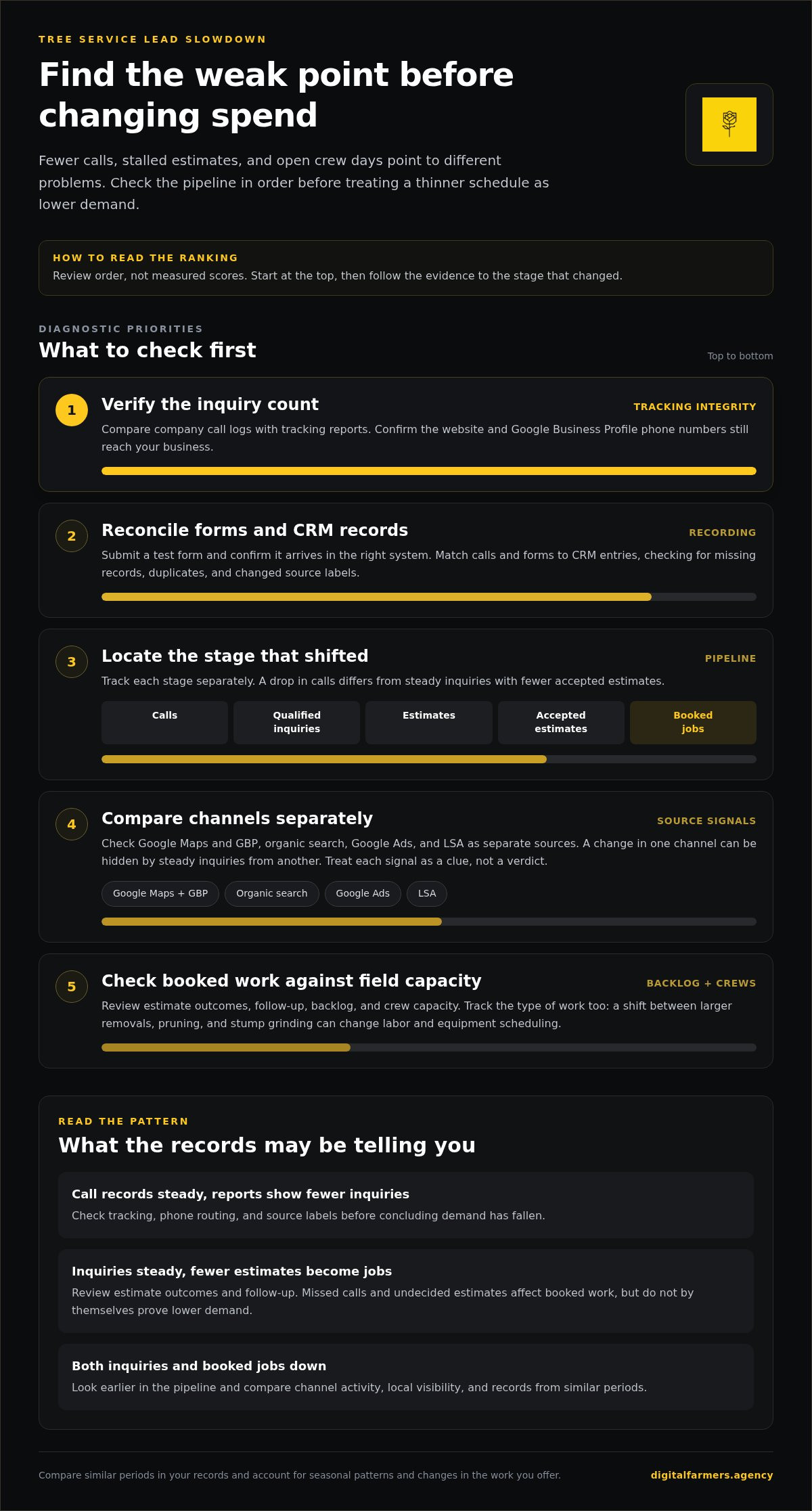
Track calls, qualified inquiries, estimates, accepted estimates, and booked jobs as separate stages. A drop in calls points to a different issue than steady inquiries paired with fewer accepted estimates. Missed calls and estimates awaiting a decision affect booked work, but they don’t prove that demand has fallen.
Compare similar periods using records you already have. If you usually book work several weeks ahead, a full schedule can hide a decline in new inquiries. Review the calls and estimates entering the pipeline, not just the jobs already on the calendar. This distinction is central to a tree company lead generation strategy focused on booked work rather than surface-level activity.
Check the effect on crews and backlog
Look at what the change means in the field. Fewer booked jobs may leave a crew underused, while a shift from larger removals to smaller pruning or stump grinding jobs can change how you schedule labor and equipment. Track the type of work as well as the number of jobs.
One open day does not establish a sustained decline. Compare the schedule gap with your past records, current backlog, and the timing of jobs already sold. If incoming estimates remain steady but booked work has slipped, focus on estimate outcomes and follow-up. If inquiries and booked jobs have both fallen, the weak point may be earlier in the pipeline.
Keep the diagnosis tied to operating decisions. A thinner backlog can affect crew planning, but more inquiries are not automatically useful if your crews are already committed to higher-value work. Use your records to decide whether you’re seeing a temporary gap or a pattern that needs attention. Your crew schedule and backlog should guide that assessment.
Check tracking before deciding that demand has fallen
A report can show fewer inquiries even when customers are still calling. A changed phone number, broken form, disconnected tracking line, or inconsistent CRM entry can make the pipeline look weaker than it is. Verify the count before treating the drop as a demand problem.
Use the same review period across your records, then check these items in order:
- Phone records: Compare your company’s call log with call tracking reports. Confirm that the number on your website and Google Business Profile still reaches your business.
- Website forms: Submit a test inquiry and confirm it arrives in the right inbox or system. Check whether form notifications or routing changed during the slowdown.
- CRM entries: Compare incoming calls and forms with new records. Look for missing entries, duplicates, or changes in how staff classify inquiries.
- Source labels: Review how calls and forms are assigned to channels. A change in labels or tracking setup can shift reported results without changing how many customers contacted you.
A tracking gap changes what you can see. A genuine decline changes how many qualified inquiries reach your business. Keep that distinction clear before adjusting spend or deciding that demand has weakened.
Reconcile calls, forms, and CRM records
Match phone logs, form submissions, and CRM entries for the same period. Check that each inquiry appears once, and that missed calls, existing-customer calls, and duplicate records aren’t counted as new qualified opportunities. Then compare the process with the period before the slowdown.
If calls to your business number stayed steady while reports show a drop, inspect tracking and source labels first. If both your call records and reports show fewer new inquiries, the decline is more likely real. If inquiries reached you but never entered the CRM, the issue is recording or follow-up, not necessarily demand.
Review Google Business Profile and Maps visibility
Confirm you can access your Google Business Profile (GBP), and check that its phone number, website, service area, and listed services are accurate. Note recent edits or access changes. Then compare map pack visibility for the tree work you want, such as removals or stump grinding, across the areas your crews serve.
Map pack results can vary by search and location, so one search from your office doesn’t show what customers across your service area see. Compare relevant searches and locations over time, then line up visibility changes with actual calls. The Google Business Profile management guide covers profile checks that support this review.
The Bureau of Labor Statistics publishes tree care industry statistics on employment and wages, but those figures don’t show local customer inquiries. Use your call records and service-area visibility to diagnose your pipeline, not workforce data as a substitute for demand tracking.
Compare channel signals to locate the weak point
Once you’ve reconciled call and form records, compare each source separately. A drop in one channel can be hidden by steady inquiries from another. Track qualified calls, estimates, and booked jobs by source where your records allow, then find the first point where activity changed.
Use this table to guide your next check. Treat each signal as a clue, not a verdict.
| Channel | Observable signal | Likely issue | Next check |
|---|---|---|---|
| Google Maps and GBP | Fewer calls from profile or map pack activity | Lower visibility, profile changes, or fewer relevant searches | Check access, listing details, service area, and visibility for high-intent searches |
| Organic search | Fewer visits or calls from unpaid search results | Reduced visibility, changed search demand, or a mismatch between page and service | Compare pages and search terms with qualified inquiries |
| Google Ads | Spend continues, but qualified calls or estimates fall | Campaign traffic, targeting, or website conversion may have changed | Review spend, inquiry quality, landing page, and cost per lead |
| LSA | Fewer LSA inquiries or qualified estimates | Profile, coverage, or account activity may have shifted | Review account status, service coverage, and inquiry records |
| Direct inquiries | Fewer calls from repeat customers or referrals | Referral flow or repeat demand may have changed | Compare caller history and inquiry type with your own records |
Read Google Maps and organic search signals
Check visibility for high-intent searches such as tree removal, tree service, and emergency tree service. Compare results across the areas your crews serve, and record whether the change is limited to one service or appears across several. Search demand, competition, service-area boundaries, and your starting visibility all affect what the change means.
A ranking position is not a booked job. Compare visibility with qualified calls and estimates before deciding that search caused tree service leads to slow down. The tree service SEO guide explains how search visibility connects to booked work.
Read paid channel and conversion signals
Review Google Ads and LSA inquiries alongside spend records and qualified estimates. If inquiries are steady but estimates are down, inspect lead quality and follow-up. If paid visits continue but calls fall, check whether visitors can quickly find your tree services, service area, and a clear way to call.
Channel activity alone does not establish booked revenue. Search impressions, clicks, and ad activity matter when they connect to qualified opportunities and accepted estimates. Don’t raise spend by default. First identify which channel changed and whether your crew capacity can use more of that work.
Work through a slowdown checklist before changing the plan
When tree service leads slow down, changing campaigns or rebuilding your website before checking the basics can discard useful work without fixing the cause. Follow these checks in order. Each one points to a different business measure and a different next move.
- Reconcile inquiries. Compare calls, forms, CRM entries, and source labels for the same review period. This establishes whether the decline is real and gives you a dependable count for cost per lead and qualified inquiries.
- Inspect each channel. Check GBP and Maps, organic search, Google Ads, and LSA separately. If inquiries fell, look for changes in visibility, account activity, or tracking before changing budgets.
- Review the website. Confirm visitors can find the tree services you want to sell, see the areas you serve, and reach a working phone number or form. Visits without calls may point to a conversion issue, not a drop in search activity.
- Assess follow-up. Review whether inquiries received a response, estimates got a decision, and prospects became booked jobs. Use close rate and booked work to locate a bottleneck after the inquiry.
These checks depend on local search demand, competition, your starting visibility, and tracking quality. Compare the findings with your backlog, crew capacity, and acceptable cost per lead. More inquiries are not useful if the work doesn’t fit your schedule or services.
Prioritize the next operational check
Let the pattern guide your action. Fewer inquiries point toward visibility and channel records. Steady inquiries with fewer accepted estimates point toward follow-up and close-rate records. Calls your crews can’t take point to a capacity decision, not an automatic push for more demand.
If calls are steady but fewer estimates become jobs, review the estimate log and follow-up process first. Increasing ad spend won’t address that stage of the pipeline. If calls have fallen across channels, check visibility and tracking before changing budgets.
Keep ownership and reporting intact
Keep company access to the domain, website, GBP, ad accounts, tracking, creatives, CRM, reporting, and customer data. These are operating assets. Replacing them without an audit can disrupt records and make performance harder to compare.
Digital Farmers audits existing marketing work and can operate alongside an in-house team. Existing campaigns and website assets don’t need to be replaced by default. Keep what is working, and change what the evidence shows is weak.
Use a county market review to choose the next step
If your records show a real slowdown, match the next move to what changed. A county market review examines search demand, which tree service businesses appear in search, and how your website and Google Business Profile are performing. That gives you a basis for deciding whether to address visibility, repair tracking, improve the website, or focus on estimate follow-up.
The review helps you assess the evidence; it does not promise future rankings, calls, or revenue. Search demand, competition, your starting visibility, service area, and tracking quality all affect what the findings mean. Identify what the evidence supports before committing more budget or replacing work that may still be useful.
Show the owner what the review examines
The findings should connect online activity to how you run the business. Relevant checks include:
- County search demand: Which tree service searches relate to the work you offer, such as removals, pruning, or stump grinding.
- Local visibility: Which businesses appear for those searches and how your GBP, Maps presence, and website compare.
- Current output: Whether your site and profile are producing calls or inquiries that align with your records.
- Operating fit: Whether the inquiry pattern, estimate volume, backlog, and crew capacity support a change in the plan.
Visibility is not the same as booked work. If the county has relevant searches but your profile and website are rarely seen, visibility may be the issue. If people reach your site but don’t call, your service details, service area, or contact path may need attention. If estimates go out without becoming jobs, marketing changes alone may not address the close-rate problem.
Set clear operating expectations
Digital Farmers works with one client per county under contractual exclusivity. That doesn’t mean every county or company is a fit, and exclusivity doesn’t guarantee a specific result. The review helps assess whether market conditions, current assets, and business capacity support a practical next step.
If advertising is part of the plan, you pay Google directly. Digital Farmers adds no markup to ad spend. Your company retains ownership of its domain, website, GBP, ad accounts, tracking, creatives, CRM, customer data, and customer list. Those assets stay connected to your business rather than relying on a rented source of inquiries.
Tree service leads slowing down can have different causes in different counties. Use your call records, estimates, backlog, and crew capacity to weigh the findings, then choose an action that fits the evidence.
Make the next move with evidence
A thinner calendar creates pressure to act, but a budget change based on guesswork can make the wrong problem more expensive. Treat tree service leads slowing down as an operating signal. Your next move should match what search demand, visibility, call records, estimates, and crew capacity show.
If inquiries are holding while accepted estimates fall, review the sales handoff before buying more traffic. If visibility has weakened, identify which channel and service area need attention first. The right response depends on local competition, your starting visibility, and whether your tracking gives you a reliable picture.
Digital Farmers has been a Tree Care Industry Association member since 2025 and focuses on marketing for tree service companies. A market review helps you identify what deserves attention and what may be working well enough to keep in place.
Frequently Asked Questions
Can tree service leads slow down even when your rankings appear stable?
Yes. Rankings, search demand, calls, and booked work measure different parts of the pipeline. Your position may look steady while fewer people search, fewer visitors call, or fewer estimates become jobs. Compare channel visibility with actual inquiries and estimates across similar periods. A stable ranking doesn’t prove that customer demand, website response, or your close rate stayed constant.
Is a drop in calls always caused by lower search demand?
No. Fewer calls can result from lower demand, reduced visibility, a tracking problem, a website issue, or calls your team missed. First confirm calls reached your business number, then test forms and reporting, review channel activity, and compare qualified inquiries. The cause depends on your market and starting conditions. Don’t treat a call decline as proof that customers stopped looking for tree work.
How do I tell whether fewer leads or a lower close rate is the problem?
Compare the stages separately. New inquiries show how many prospects contacted you. Qualified estimates, accepted estimates, and booked jobs show what happened after contact. Review call logs, CRM entries, estimate records, and close-rate records for the same periods. If inquiry counts dropped, inspect lead sources. If inquiries held but fewer estimates became jobs, focus on job fit and the estimate process.
What should I do when calls are steady but estimates are not turning into jobs?
Start with your estimate records, not your ad budget. Check which estimates remain undecided, whether follow-up happened, and whether the requested work fits your services and schedule. Compare the close rate for similar work where your records allow. If crews are booked or the work mix has shifted, that can affect what you accept. A channel change alone may not fix conversion.
Can a website issue reduce tree service inquiries even if traffic has not fallen?
Yes. Traffic counts visits, while inquiries show whether visitors contacted you. Review the pages receiving visits and check that tree services, service-area details, and contact options are clear. Test the forms and phone links, then compare tracking reports with your actual call records. A steady visit count doesn’t prove the site is producing inquiries, but it also doesn’t prove a redesign is needed.
How much should I change my marketing budget when leads slow down?
Don’t change the budget until you know what changed. Reconcile calls and forms, verify tracking, compare channel performance, and check whether qualified estimates fell. Then weigh the findings against local search demand, competition, current visibility, campaign records, and crew capacity. If your schedule can’t absorb more work, added spend may not help. The right budget decision depends on what your records show in your market.
Book a market review for your county. You see search demand, who is ranking, and what your profile and site are producing right now, before anything changes. Call +1 (603) 802-6879.