

A storm has passed, your phone is ringing, and your crews already have a full schedule. Tree service marketing for storm season works best when your local presence is built before the weather turns, your updates match the work you can take, and every call is measured against crew capacity. That’s how you earn local calls without looking like you’re chasing damage.
Storm work can bring urgent jobs and sudden pressure on dispatch. If your campaign promises immediate service while your crews are booked, it sets the wrong expectation. Keep your service-area information, current availability, and storm updates clear so homeowners know what you can handle and when.
Prepare your Google Business Profile and local search presence, build storm-focused ads and landing pages, and follow up without turning every message into a sales pitch. After calls come in, track qualified leads, cost per lead, close rate, booked revenue, and backlog. The goal is a pipeline that fits your crews, not a spike in calls you cannot serve.
Key Takeaways
- Keep your Google Business Profile, service area, and contact details current before storm demand rises.
- Match emergency ads and landing pages to the work your crews can actually take on.
- Prepare separate storm-response and seasonal tree-care campaigns so your marketing stays useful beyond urgent cleanup.
- Use clear, timely profile updates and review responses to build local trust without overstating availability.
- Measure lead quality, cost per lead, close rate, booked revenue, and backlog to see whether campaigns fit your operation.
1. Pre-storm local SEO and Google Business Profile optimization
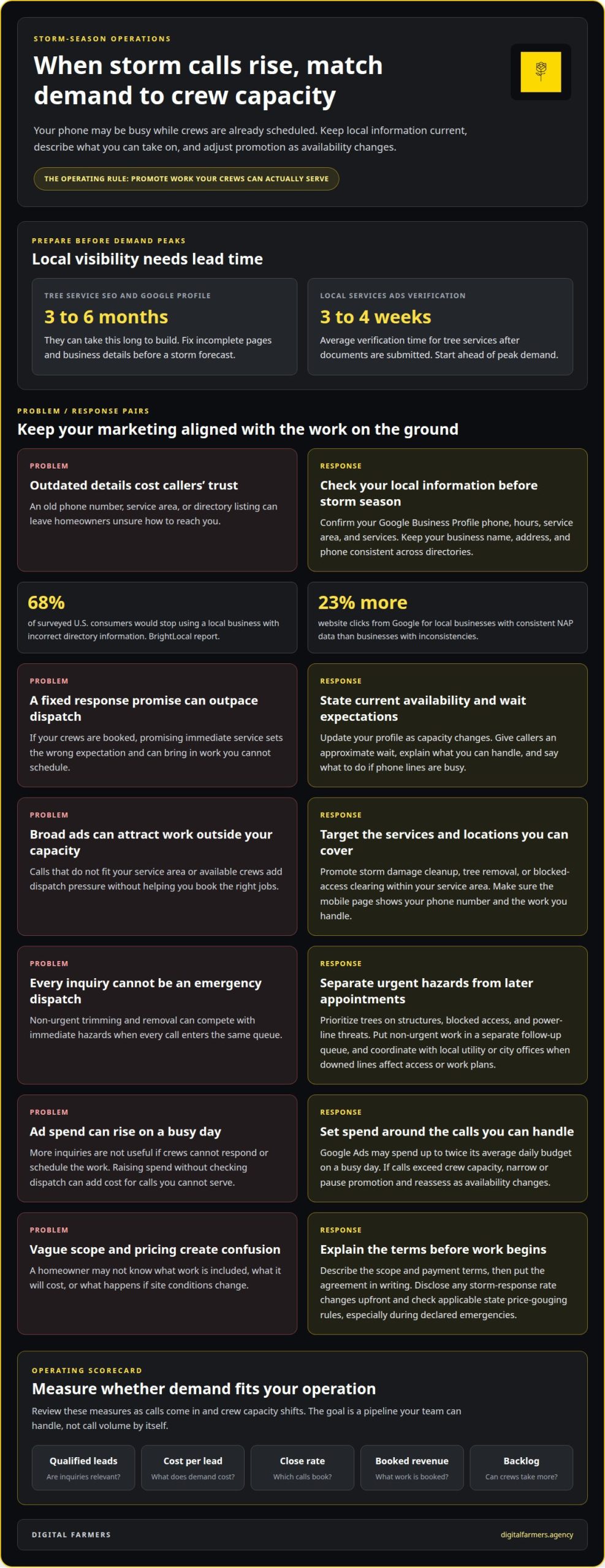
Before storm calls start, make your Google Business Profile accurate and useful. Confirm your phone number, service area, hours, and tree services, including emergency tree removal, storm damage cleanup, and trimming. Keep the same business name, address, and phone details across online directories. BrightLocal reports that 68% of surveyed U.S. consumers would stop using a local business with incorrect directory information.
For storm damage calls, update your profile with current availability and response expectations. Explain what your crews can handle, where they work, and what callers should do if your lines are busy. Do not claim immediate response if your schedule cannot support it. Clear updates help callers understand the situation before requesting service.
Target searches that connect the emergency, service, and location. Examples include “storm damage tree removal in [town],” “emergency tree service in [county],” and “fallen tree cleanup near [town].” Build or update service pages that explain the specific work and area. The map pack shows three local results, so accurate business details and relevant service information help your listing compete for visibility.
Search visibility takes preparation. Tree service SEO and a Google profile can build over 3 to 6 months, so don’t wait for a storm forecast to fix incomplete pages. Local Services Ads verification for tree services averages three to four weeks after documents are submitted. Start the process before peak storm demand, then schedule campaigns around your available crews and service area.
Before storm season, update contact details for local utility and city offices. Set a clear coordination route for emergency response, especially when downed lines affect access or work plans. Do not advertise work your crews are not equipped or trained to perform. Accurate coordination supports safer dispatch decisions and helps callers distinguish tree work from utility response.
During a storm, post timely updates on your profile and relevant local groups. Say whether your company is working, give an approximate wait time, and explain what callers should do if phone lines are busy. Update the message as crew capacity changes. Consistent information across your profile, local posts, and website keeps demand aligned with the work you can book.
Consistent NAP data offers another practical benefit: local businesses with consistent NAP data receive 23% more website clicks from Google than businesses with inconsistencies. Keep contact details aligned wherever customers look for service.
Relationships with local government agencies can support emergency response coordination when downed power lines affect access or work plans.
2. Emergency-focused search and social advertising
When storm calls rise, match your campaign to the work your crews can take. Promote specific services such as storm damage cleanup, tree removal, and clearing blocked access. Keep targeting within your service area, then compare incoming calls with dispatch capacity. More demand helps only when your team can respond and schedule the work.
Google Ads can reach people actively searching for urgent tree work. Facebook and Instagram posts can update people who already follow your company. Use each channel to explain which jobs you handle and how callers can reach you. Make sure your mobile landing page displays your phone number, service details, and a clear way to request help.
Describe response times based on current capacity. Give callers an approximate wait and explain that scheduling depends on the job and crew availability. Before work begins, explain the scope and payment terms, then put the agreement in writing. Avoid fixed response promises and vague pricing language that leave homeowners unsure what they are accepting.
Storm response rates may differ from routine work when the increase is justified and disclosed upfront. Check applicable state price-gouging rules, especially during declared emergencies. Clear estimates and written terms help homeowners understand the price before crews start. They also document the agreed scope if conditions change on site.
Not every storm inquiry needs emergency dispatch. Offer later appointments for non-urgent trimming or removal while crews address immediate hazards. Keep those jobs in a separate follow-up queue. Dispatch can then prioritize trees on structures, blocked access, and power-line threats while preserving later work at normal margins.
Set campaign spending according to the calls your operation can handle. Google Ads may spend up to twice its average daily budget on a busy day, so account for that before raising spend. Track qualified calls, booked jobs, and backlog as demand shifts. If calls exceed crew capacity, narrow or pause promotion rather than paying for inquiries you cannot serve.
Keep storm messages factual. Show the type of response work your crews perform, and avoid language that implies every caller will receive immediate service. Use advertising support for tree service companies to connect campaign targeting with real dispatch capacity, rather than chasing call volume without regard to booked work.
3. Preparing marketing campaigns ahead of storm and pruning seasons
Build storm cleanup campaigns before crews are dispatched. Start preparing a few months before hurricane season. Draft service messages, choose the areas your crews can reach, and plan how to handle calls if demand rises. Use customer records to send seasonal reminders about storm preparation and tree care, not alarmist claims about damage.
Local weather patterns affect when search demand rises and which services callers need. A company in a hurricane-exposed area may plan around hurricane season, while another market may have different storm periods. Use your call records and booked work to identify when demand has arrived before. Set campaign timing and service areas to match those patterns and available crew capacity.
Pruning and removal campaigns need a different schedule. Plan a dormant-season pruning campaign in early autumn, ahead of late autumn through winter, generally a better time for structural pruning and many removals. Winter can make defects easier to see beneath bare canopies. Inactive trees and often firmer ground can also make the work practical, depending on site conditions.
Build the storm-response campaign before you need it, then keep it paused until conditions justify activation. Prepare ad copy, landing page details, call routing, and target areas in advance. Describe the storm damage cleanup and tree removal work you actually do. Do not imply that every address is within reach or every urgent call can be booked immediately.
Before activating a campaign, compare crew schedules with your service area and expected demand. Make sure the message matches what dispatch can offer, whether that is an assessment, a scheduled job, or urgent response. Separate emergency inquiries from non-urgent trimming and removal requests. This keeps a sudden increase in calls from filling the backlog with work your crews cannot schedule.
For example, a tree service company in a county that tracks hurricane forecasts can prepare a storm campaign before the season begins. It can keep the campaign paused during normal operations, then activate it when local conditions and crew capacity support more calls. A separate dormant-season campaign can promote planned pruning and removal for customers who do not need emergency work.
Review both campaigns after each seasonal run. Compare inquiries with booked jobs, close rate, and work completed by your crews. If storm advertising brings calls from outside your service area, narrow the targeting. If pruning inquiries arrive while crews are committed to cleanup, adjust campaign timing to match available capacity.
4. Google Business Profile optimization
Storm cleanup photos and customer reviews give your profile evidence beyond a service list. Choose completed tree removal or storm damage cleanup jobs that show the work your crews handle. Use clear images with useful context, and avoid repeating the same image. Your profile should help homeowners understand your actual work, not look like a collection of generic tree photos.
Add a review request to your job closeout process. After completing a storm job, send the customer a straightforward request to describe their experience in their own words. Do not write a review for them or pressure them to praise your company. Genuine feedback helps future customers understand your communication, cleanup, and completed work.
Respond to reviews with details that show you understood the job. Thank the customer for a specific service, such as removing a fallen limb or clearing storm debris. For criticism, acknowledge the concern and move private job details out of the public reply. Keep your response factual and calm, even when a review feels unfair.
BrightLocal’s 2025 survey found that 89% of consumers were more likely to choose a business that responds to all reviews. Treat each response as part of the profile’s public record. Assign review monitoring to a specific person, and use a simple closeout checklist so customer feedback doesn’t get lost during a heavy storm workload.
Star ratings alone don’t tell the whole story. BrightLocal’s 2025 survey found that 9% of consumers said star rating does not matter when considering a local business. Keep the profile’s service information and real customer feedback aligned, so a homeowner can judge more than a number before calling about a damaged tree.
Review your profile as a homeowner would after seeing a storm damage photo or review. Confirm that listed services describe work you actually do, and remove outdated images that no longer represent your operation. If a review mentions a service you do not offer, clarify the scope politely rather than letting an inaccurate impression stand.
Make profile maintenance a repeatable closeout task, not a cleanup project after the season. After each storm job, check whether you sent a review request, responded to new feedback, and added useful project photos. This keeps your profile grounded in recent tree work without turning every post into an emergency sales message.
5. Storm-season marketing performance metrics
Storm demand can fill your phone without filling your schedule profitably. Track each emergency tree inquiry from first contact through estimate, booking, and completed work. Record the source, service requested, location, response time, and outcome. This shows whether tree service marketing for storm season brought qualified homeowners or calls your crews could not serve.
Raw lead counts can mislead. A campaign may generate calls from outside your service area, requests for work you do not perform, or callers who never book. Track those separately from valid storm cleanup and removal opportunities. Use close rate and booked revenue to judge whether the campaign needs adjustment.
Keep revenue calculations separate from forecasts. Actual booked revenue depends on which jobs close, each job’s scope, crew capacity, and the work your company can complete.
Include call handling in the same report as advertising. Track missed calls, callback time, estimates sent, and jobs booked. Compare those figures with dispatch capacity and backlog. If inquiries rise while crews cannot take on more work, pause or narrow promotion instead of paying for calls you cannot convert.
Measure customer satisfaction alongside job and call data. Review feedback after storm damage work, and note recurring concerns about communication, arrival expectations, or completed scope. Compare those patterns with response times. This helps distinguish a marketing problem from a dispatch or customer-service issue.
Review results by campaign, service, and location after each storm period. A county-level breakdown can show whether emergency tree searches lead to better bookings than broader storm cleanup messages. Base comparisons on completed work, not clicks alone. When updating your Google Business Profile, compare calls and booked jobs before and after the change, while noting other campaign activity.
Use those findings to adjust the next campaign’s service area, message, and budget. A tree service marketing for storm season review should connect lead quality with booked work and crew capacity. A county market review can help assess how current inquiries fit your operation.
Digital Farmers
Digital Farmers connects local visibility with calls your crews can handle. Its services include SEO, Lead Generation, Google Business Profile, and AI Search. The focus is practical: service-area demand, qualified inquiries, booked jobs, and crew capacity.
Turn to Digital Farmers when storm campaigns need clearer measurement, your profile needs consistent management, or search inquiries are not becoming scheduled work. The right approach depends on your county, current visibility, and capacity to take on additional jobs. More calls help only when they fit your operation.
Contact Digital Farmers for a market review call for your county at +1 (603) 802-6879.
Build the system before the next storm
The next storm forecast is too late to start fixing missed calls, unclear service areas, or campaigns that don’t match crew capacity. Treat tree service marketing for storm season as an operating system, not a burst of emergency promotion. It should help the right local homeowners reach you, then show whether those inquiries turn into booked work.
Digital Farmers connects SEO, Lead Generation, and Google Business Profile work to the calls and jobs your business needs to track. This support fits when your local visibility or measurement needs work and you want marketing aligned with your service area and crew schedule.
For a practical next step, contact Digital Farmers for a market review call for your county at +1 (603) 802-6879. Build your storm plan around real capacity, and meet the next busy stretch prepared.
Frequently Asked Questions
How do I avoid looking like a storm chaser?
Keep public messaging useful before, during, and after severe weather. Share practical tree-care information in quieter periods, then focus storm updates on work status and service limits, not fear. After cleanup, contact customers about routine maintenance only when it fits their property and needs. A steady, year-round presence shows that storm response is part of your operation, not a temporary rush for urgent jobs.
Should I raise my ad budget when a storm is forecast?
Increase spending only when your crews can take more work and someone can answer incoming calls. Set a clear limit, then review qualified inquiries, booked jobs, and cost per booked job as demand changes. If calls go unanswered or your backlog is already beyond workable capacity, extra spending can waste budget and harm customer expectations. A forecast alone is not a reason to increase your campaign.
What marketing channels work best for emergency tree service leads?
Use channels that reach people at different decision points. Google Ads and Local Services Ads can target active searches for urgent tree removal, while your Google Business Profile helps local homeowners find and call your company. Social posts can share operational updates with people who already follow your business. Compare each source by qualified calls and booked work, then keep the mix that fits your service area and dispatch capacity.
How much should a tree service spend on storm season marketing?
There is no useful budget figure without knowing your service area, crew capacity, current cost per lead, and close rate. Start with an amount your business can support, then measure how much turns into booked work and completed jobs. Consider whether dispatch can answer calls and crews can meet the schedule. Adjust spending based on operating results, not the size of the storm forecast.
How can tree services build relationships with insurance agents, roofers, and property managers before storms?
Make introductions before severe weather creates urgent demand. Explain the tree work your crews handle, the areas you serve, and how partners can reach your office. Give insurance agents, roofers, and property managers one clear contact path and a concise description of the information you need to assess a referral. After the season, review how coordination worked and keep the relationship useful between storms.
How can tree services avoid scams, misleading claims, and reputation damage after a storm?
Use your real business name and contact details in every ad, post, and estimate. Describe the work you can perform, explain the agreed scope before starting, and never imply an insurer or utility has approved your company unless that is true. Keep job records and customer communications organized. If a complaint appears online, respond calmly, address the issue directly, and avoid sharing private property or customer details.