
A postcard budget only works when it fits your crew capacity and service area. For tree company direct mail marketing, spend depends on the number of homes you mail, how you select them, and the cost of printing and postage. A large mailing is wasted if it reaches homeowners you cannot serve.
You know what a slow week costs: crews still need schedules, equipment still carries overhead, and your phone still needs to ring. Direct mail can put your services in front of homeowners, but it needs a clear audience and a way to track calls and booked jobs.
Set your budget, choose routes, plan the mailing schedule, and create a postcard with a clear reason to respond. Then connect each mailing to your digital marketing and track whether it generates calls and where those inquiries fit in your sales pipeline.
Key Takeaways
- Set your mailing budget around the homes you want to reach, the format you choose, and the work your crews can take on.
- Choose neighborhoods based on service fit and likely residential demand, not just the number of addresses on a route.
- Match mailing frequency to the campaign: steady neighborhood awareness calls for a different schedule than storm response or seasonal maintenance.
- Build postcard offers around a specific tree service and a clear next step, so homeowners know how to respond.
- Connect mail with your digital channels and track calls, estimates, and booked work to understand what each campaign contributes.
1. Is EDDM good for tree service companies?
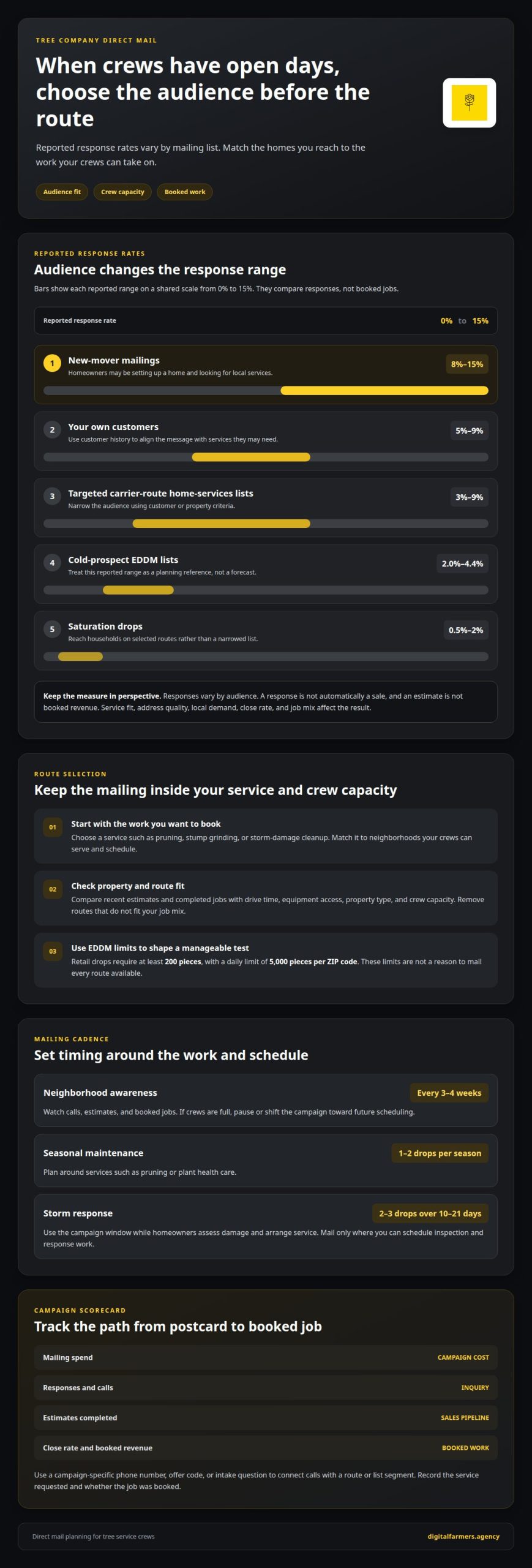
When your schedule has open crew days, EDDM can put a tree service offer into nearby mailboxes. Response rates vary by audience: saturation drops are reported at 0.5% to 2%, targeted carrier-route home-services lists at 3% to 9%, and new-mover mailings at 8% to 15%. Mailings to your own customers are reported at 5% to 9%.
These mailing approaches serve different purposes. Saturation mail reaches households on selected routes, while a targeted list narrows the audience by customer or property criteria. New movers may be setting up a home and looking for local services. Match the list to the work you want, such as pruning, stump grinding, or storm-damage cleanup.
Carrier-route targeting works best when you compare routes with your service area and job mix. Start with neighborhoods where properties fit your equipment, crew capacity, and preferred work. A route with many commercial addresses may waste spend if most of your jobs come from residential customers. Keep routes you can serve and remove poor-fit areas.
Direct mail gives you a physical message delivered to a defined area during a campaign window. It can promote a seasonal service or reach homeowners near a completed job. An offer might invite a homeowner to request an estimate, ask for a tree assessment, or consider a service bundle. Name the service and give one clear response step, such as calling for an estimate.
For campaign review, focus on whether service, savings, or credential claims are supportable and whether the recipient list is appropriate for your intended use. Check those details against the specific offer and audience before mailing.
Direct mail reaches homeowners differently from Google Ads, door hangers, and local SEO. Google Ads can reach people searching for tree work, door hangers can target homes near a completed job, and local SEO supports discovery in search. Mail gives you a scheduled physical touchpoint. Track calls and booked work to understand its contribution alongside other channels.
Measure campaign performance using spend, responses, estimates, close rate, and booked revenue. A campaign-specific phone number, offer code, or intake question can help connect calls to a mailing. Compare booked work with campaign cost: a response is not automatically a sale, and an estimate is not booked revenue. Your close rate and job mix affect whether the mailing paid off.
For example, a route might generate calls for pruning while your crews are booked for removals. The mailing may create interest without filling the capacity you need. Adjust the next offer or route to match the work you can schedule. Track the audience, service requested, estimate, and booked job to evaluate your tree company direct mail marketing.
2. Targeting neighborhoods with EDDM and mailing lists
Your service area may cover several ZIP codes, but one mailing won’t fit every block. Start by choosing 2–3 customer types, such as homeowners planning pruning, properties needing removal, or households requesting plant health care. Then match each group to neighborhoods your crews can serve and the work you want to book.
EDDM lets you select carrier routes within ZIP codes rather than supply individual addresses. Retail drops require at least 200 pieces, with a daily limit of 5,000 pieces per ZIP code. Use those limits to build a manageable test area, not a reason to mail every route available.
Map recent estimates and completed jobs by address to find promising neighborhoods. Look for clusters where the same service keeps coming up, then compare those areas with your drive time, equipment access, and crew capacity. A pocket of homes near recent pruning work may suit a maintenance offer better than a route that generates mostly removal requests.
Property type matters. Separate homes with mature trees from areas dominated by newer construction or commercial sites, using the address and property filters available for your mailing list. For storm-risk targeting, start with your own storm calls and job locations. Focus on affected neighborhoods where you can still schedule inspections and response work.
Build a mailing list from your customer database, past estimate requests, and referral records. Clean addresses, group records by service history, and separate past customers from prospects. For a purchased list, set your ZIP codes, homeowner audience, property criteria, and service requirements before selecting records.
Cold-prospect EDDM lists have reported response rates of 2.0% to 4.4%. Treat that range as a planning reference, not a forecast for your route. The offer, address quality, local demand, and fit between the advertised service and the neighborhood all affect response.
Tie tracking to the mailing area. Record the route or list segment, calls received, services requested, estimates completed, and jobs booked. If addresses near a completed crane-assisted removal generate nearby inquiries, note the pattern and use it to guide future neighborhood selection.
Good targeting narrows the drop to households that fit your work and schedule. A county-level direct mail plan can help organize routes, list criteria, and campaign tracking around your service area.
3. How often should a tree service send direct mail?
Your mailing schedule should follow the work you can book, not a calendar habit. For neighborhood awareness, send postcards every 3–4 weeks, then watch calls, estimates, and booked jobs. If your crews are full, pause the campaign or shift it toward future scheduling.
Seasonal maintenance needs a different cadence from urgent storm response. Plan 1–2 drops per season for maintenance work, such as pruning or plant health care. For storm response, 2–3 drops over 10–21 days can keep your company noticed while homeowners assess damage and arrange service.
Build each campaign around one service, one audience, and one response path. Set the route or list, confirm delivery timing, and prepare the postcard before distribution. A clear schedule helps you compare each mailing without confusing its calls with referrals, Facebook activity, or other advertising.
USPS EDDM Retail does not require a mailing permit. Bulk EDDM requires a permit and an annual fee. EDDM postage is an option for qualifying route-based mailings, while addressed mail uses individual recipient addresses. Choose based on whether route coverage or precise address selection better fits the campaign.
Paper and preparation matter. The cited USPS Domestic Mail Manual standard in Section 201, Sub-Section 5.2.2 sets a minimum paper thickness of 0.007 inches for EDDM printing. Working with an established commercial printer such as Linemark ensures your materials meet the required format and postal paperwork specifications before sending a drop to distribution.
Track responses with a campaign-specific phone number, landing page, or offer code. Keep mailing dates, target routes, call records, estimates, and booked work in your own business records. Your reporting system should hold this data, not just a vendor’s campaign dashboard.
Separate calls by service and outcome. Record whether a homeowner asked about storm-damage cleanup, pruning, or removal, then note whether the estimate became booked work. This shows which campaign generated useful demand and whether your close rate supports another mailing.
Don’t resend the same mailer automatically. Leave at least three years between cycles when repeating the same mailer, and revise the offer or service focus sooner if conditions change. For example, a storm campaign should reflect actual local damage and available crew capacity, not competitors’ activity or a Facebook post alone.
4. Postcard offers, design, and calls to action
A postcard should give a homeowner one clear reason to contact your tree service. Choose an offer tied to work you want to book, such as a pruning estimate, a tree assessment, or a service bundle combining removal and stump grinding. A sample offer suggests saving $50 for new customers, but the amount must fit your margins and the job’s scope.
Make the next step obvious. Ask the reader to call for an estimate, request an assessment, or schedule a specific service. Place the phone number and instructions where they are easy to find. One clear action is better than competing requests to call, visit a website, and follow your social accounts.
Use 3–6 bullets to identify services or benefits, not to crowd the postcard with every capability. For example, a pruning card might mention pruning, cabling and bracing, and plant health care. Keep the offer specific to the route’s likely needs, so the mailing generates relevant inquiries rather than calls your crews cannot convert.
Design for a quick read. Use 2–3 colors from your existing branding, strong contrast, and a headline that names the service. A photograph of a crew handling a tree removal can make the work recognizable, while a short caption can explain the offer. Keep the phone number and call to action visually distinct from supporting copy.
Base urgency on a real reason to act, such as seasonal pruning or a limited scheduling window tied to crew capacity. Don’t advertise a deadline or discount you won’t honor. For a storm-response postcard, state the service offered and the area covered. Avoid broad promises about response speed or results.
Match the format to the job. A postcard is compact and direct; a larger mailer gives you room to explain a complex service bundle or assessment process. Whichever format you choose, use the same offer, phone number, and campaign identifier in the design and tracking. That makes responses easier to attribute to the mailing.
Reusing a design can reduce production work, but an unchanged card may feel irrelevant when the service, season, or audience changes. As noted in the cadence section, avoid repeating the same mailer too soon. Update the headline, image, offer, or service focus when the next campaign has a different purpose.
Before printing, check every detail against the work you can schedule. Confirm the offer terms, service area, phone number, and response path. A postcard about crane-assisted removal should invite estimate requests, while a plant health care card should clearly focus on that service.
5. Combining direct mail with digital marketing
A postcard can start a conversation, but homeowners may look you up before calling. Make sure the service information on your website and Google Business Profile matches the mailer. If the postcard promotes pruning, make that service easy to find online. Keep your service area, phone number, and estimate request consistent across each touchpoint.
Give the mailing a trackable response path. Use a campaign-specific page or response code, then record calls, estimate requests, and booked work against the mailing. Ask callers how they heard about you, too. This can identify homeowners who saw a postcard and later found your number through search or your Google Business Profile.
Keep the digital message aligned with the printed offer. If a postcard promotes storm-damage cleanup, the landing page should explain that service and make the next step clear. An unrelated homepage forces homeowners to search again. Consistency helps you trace the inquiry and determine whether it fits your crews.
Use search advertising to reach homeowners actively looking for a tree service, while direct mail puts your offer in selected neighborhoods. Each channel has a different role. If a mail recipient searches for your company, your Google Business Profile and website should support that next step with accurate services, contact details, and a clear estimate process.
Follow-up can connect channels without flooding your customer database. For example, send a relevant marketing email three weeks after a prospect’s initial contact if you have permission and a useful reason to follow up. Refer to the service they asked about, such as pruning or stump grinding, and give them one straightforward way to request an estimate.
Measure more than clicks. Compare printing and postage costs with calls, completed estimates, close rate, and booked revenue. Separate mail-driven inquiries from digital inquiries where possible, but note when a customer encountered both. This gives you a more accurate picture than crediting only the last click.
Review the results before the next drop. If mail generates calls but few booked estimates, check the offer, service fit, and follow-up process. If digital inquiries arrive from outside your service area, adjust the campaign’s geographic focus. Keep the channels working from one plan, not competing calendars. Request a market review of your direct mail and digital plan to map those pieces to your county and crew capacity.
Digital Farmers: SEO
Digital Farmers helps tree service companies connect direct mail with Lead Generation, Google Business Profile, and AI Search. These channels can support your marketing when homeowners respond to a postcard by looking up your company, or when mail generates calls but your online presence does not clearly guide the next step.
Your Google Business Profile and online information should match the services, service area, and contact details on your mailers. That consistency helps homeowners confirm they have found the right tree company before requesting an estimate. AI Search and Lead Generation can support the broader effort to make your business easier to find and contact.
Digital Farmers can help align these parts of your marketing around your service area and crew capacity. Contact Digital Farmers to discuss your county’s marketing needs.
Plan the Next Mailing Around Crew Capacity
Give the next mailing a clear purpose before setting its print date. Decide whether you need to fill pruning capacity, bring in removal estimates, or stay visible in neighborhoods where your crews already work. Judge the campaign by the calls and booked work it contributes, not by how polished the postcard looks.
A practical tree company direct mail marketing plan belongs alongside your dispatch calendar. Match the offer, service area, and follow-up to the work your team can schedule. This keeps marketing decisions connected to field operations and customer demand.
For help planning the next campaign around your county and capacity, request a market review with Digital Farmers or call +1 (603) 802-6879. Put the next mailing to work on a real business priority, and keep your crews focused on the jobs you’re equipped to handle.
Frequently Asked Questions
How Much Should I Expect to Spend on Direct Mail Marketing?
Build your budget from the campaign components: audience selection, creative production, printing, postage, and response handling. Before approving the spend, estimate what a booked job contributes after labor, disposal, and equipment costs. Your acceptable acquisition cost depends on job margin and close rate. Keep the campaign manageable so you can evaluate it without putting payroll or scheduled field work under pressure.
Is EDDM good for tree service companies?
EDDM can suit a company whose work is concentrated in a defined local market. It may be a weaker fit if your service area spans distant communities or your crews have little capacity to travel between jobs. Before choosing routes, compare them with dispatch patterns and the work you want to sell. Routes should support efficient scheduling, not just expand household reach.
EDDM or addressed lists: which one fits?
Choose an approach that fits how you manage customer records. For addressed mail, remove outdated contacts, duplicate households, and customers who should not receive another offer—platforms like Postal Methods can then handle printing, folding, and mailing your letters directly to recipients. For route-based delivery, consider how much of the selected area overlaps with current customers. This preparation reduces wasted contact and helps you distinguish new demand from repeat business.
How can I avoid looking like every other direct mail piece?
Choose services that reflect the work your company actually does. A postcard about complex removals can explain what homeowners should prepare before an estimate, while a pruning card can describe the tree conditions you assess. Use language your crew would use on site. Specific, practical information gives readers a reason to pay attention beyond a discount or generic claim.
How often should a tree service send direct mail?
Plan campaigns in stages, not just as repeated mailings. An initial postcard can introduce a service, while a later message can address another homeowner concern or explain what happens during an estimate. Don’t keep sending the same message if the first campaign produced no useful conversations. Review call notes and crew availability before continuing, changing the offer, or pausing.
What Should Marketing for Tree Services Really Look Like?
Your marketing should reflect how tree work is sold and delivered. Homeowners may need to understand whether a job involves pruning, removal, or an assessment before requesting an estimate. Explain those service differences on your website, in customer follow-up, and in printed materials. Make sure the person answering the phone can route each inquiry to the right estimator and available crew schedule.
What are the most common mistakes in direct mail design?
A common mistake is promoting an offer without explaining its limits. If a discount applies only to a particular service, say so clearly to set the same expectation with homeowners and your office. Avoid unexplained technical terms, too. Describe cabling and bracing in plain language and explain the customer concern the service addresses.
How effective is direct mail marketing for tree service companies?
Its value depends on whether it brings in work that fits your service mix and operating margin. Review the kinds of requests it produces, not only the total response. A campaign drawing mostly small pruning inquiries may serve a different business need than one generating removal estimates. For a county-specific view of your market and current marketing, book a market review call at +1 (603) 802-6879.