

Your crews are working, the phone is ringing, and the monthly report says leads are up. But that does not tell you which calls came from advertising, which became booked jobs, or what it cost to generate them. A tree service advertising agency should provide call-level tracking and explain who owns the phone numbers, lead records, and campaign data.
Looking beyond the lead count is sensible. A storm cleanup call, a stump grinding inquiry, and a crane-assisted removal have different job requirements and value to your schedule. Reporting should show whether advertising is bringing in work that fits your service area, close rate, backlog, and crew capacity.
This checklist covers the practical details: agency services, creative, media buying, tracking, lead and data ownership, and tree-service experience. Use it to assess an agency before committing, understand what a useful report should show, and decide whether its services fit your operation.
Key Takeaways
- Compare the work an agency actually handles, from creative and media buying to digital campaigns, against the gaps in your current lead pipeline.
- Check whether campaign reports connect calls to qualified inquiries, booked jobs, cost per lead, and crew capacity.
- Clarify who controls lead records, campaign data, and tracking phone numbers before work begins.
- Look for experience that accounts for tree work differences, including storm damage cleanup, stump grinding, and crane-assisted removal.
- Use the agency comparison checklist to separate useful operating information from surface-level activity reports.
Agency services including creative, media, and digital marketing
Your crews may be booked for removals while next week’s schedule is still thin. An agency’s service list matters only when its work connects advertising to calls, estimates, and jobs your crews can handle.
For tree removal and trimming, use search advertising, Local Services Ads, and a clear Google Business Profile to reach homeowners looking for those services. Match each campaign and landing page to the job type and service area, then track calls and booked work.
Creative should reflect the work you actually perform. A removal campaign needs different messaging from one for pruning, stump grinding, or storm damage cleanup. Check that ad copy names the service, describes the area served, and gives homeowners a clear way to call or request an estimate.
- Search ads: Review the search terms and landing page for removal, trimming, and other offered services, so inquiries match your work.
- Local Services Ads: Confirm that the service categories and service area fit your crew coverage, instead of drawing calls from locations you cannot serve.
- Google Business Profile: Make sure the profile reflects your current services, phone number, and operating area, since homeowners may use it before calling.
- Website pages: Compare a removal page with a trimming page; each should explain its service clearly and make the next step easy to find.
Ask how the agency manages media buying, not just ad design. A campaign needs a defined audience, service area, budget controls, and reporting that distinguishes calls from clicks. Reports should show which campaign generated inquiries and whether those inquiries became estimates or booked jobs.
Check the contract term, renewal language, cancellation process, account access, and included work before signing. Agencies and lead platforms may require tree service businesses to sign contracts lasting 6 or 12 months, so identify the commitment and what happens when the term ends.
Clarify who pays advertising costs and what the agency fee covers. Get the deliverables, reporting schedule, campaign changes, and ownership terms in writing. A low cost per lead means little if calls come from outside your service area or concern work your crews cannot perform.
Use a real job as a test case. Ask the agency to show how its reporting distinguishes inquiries and connects them to your close rate, booked revenue, and available crew capacity.
Media planning and buying
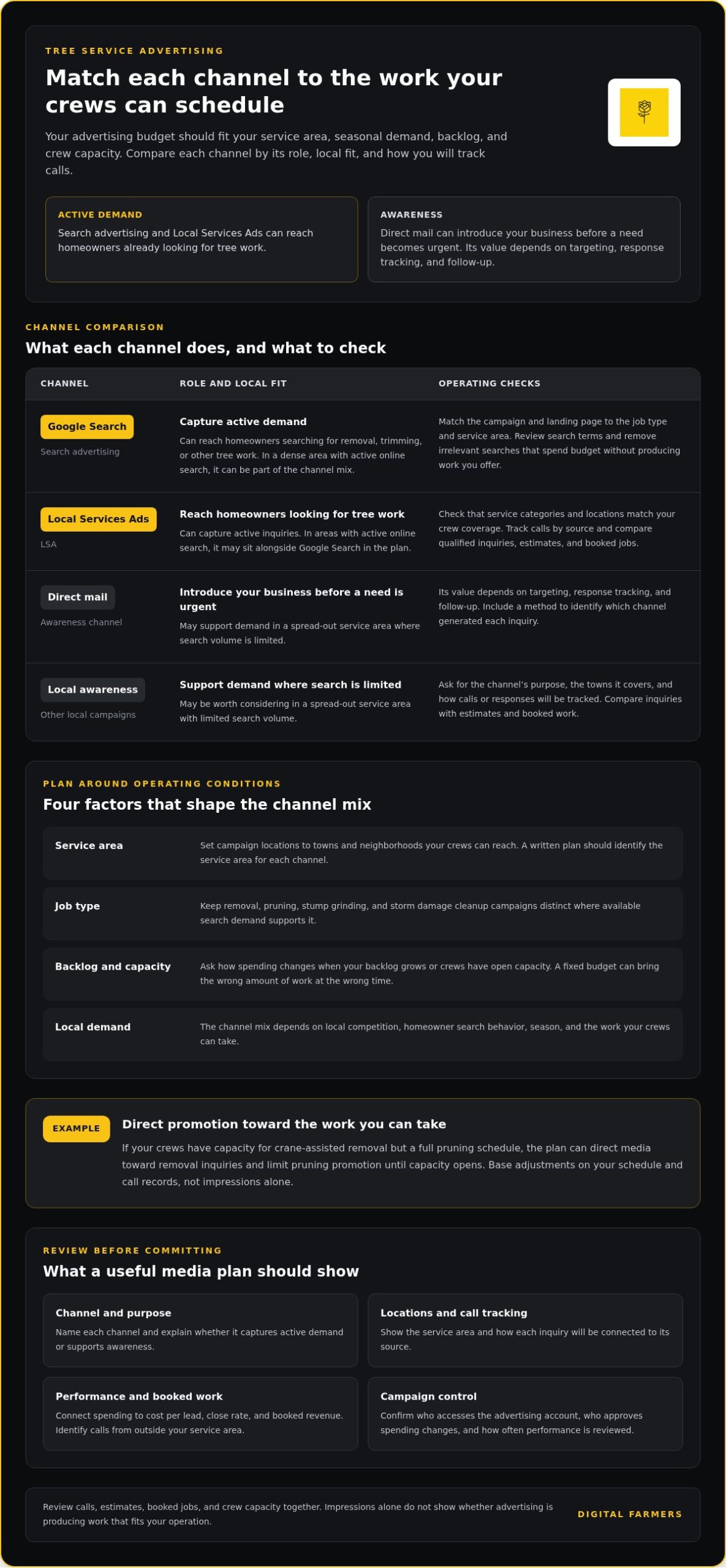
Your advertising budget should fit the work you can schedule, not just the clicks a campaign reports. Build the media plan around your service area, seasonal demand, crew capacity, and the jobs you want more of. Search ads, Local Services Ads, direct mail, and other channels reach homeowners in different ways.
The best channel mix depends on local demand. In a dense area with active online search, Google Search and Local Services Ads can reach homeowners already looking for tree work. In a spread-out service area, direct mail or local awareness campaigns may support demand where search volume is limited.
Start with a channel plan that separates active demand from awareness. Search advertising and Local Services Ads can capture inquiries from people looking for removal or trimming now. Direct mail can introduce your business before a need becomes urgent, but its value depends on targeting, response tracking, and follow-up.
Ask for a written plan that identifies each channel, its purpose, the service area, and the call-tracking method. The agency should explain how it adjusts spending when your backlog grows or crews have open capacity. A budget that stays fixed while your schedule changes can bring the wrong amount of work at the wrong time.
- Set service boundaries: Match campaign locations to the towns and neighborhoods your crews can reach.
- Separate job types: Keep removal, pruning, stump grinding, and storm damage cleanup campaigns distinct where the available search demand supports it.
- Track calls by source: Record which channel generated each inquiry, then compare qualified calls, estimates, and booked jobs.
- Review search terms: Remove irrelevant searches that use budget without producing work you offer.
For example, if your crews have capacity for crane-assisted removal but a full pruning schedule, the plan should reflect that. The agency can direct media toward removal inquiries and limit promotion for pruning until capacity opens. Adjustments should be based on your schedule and call records, not impressions alone.
Media buying also requires clear control of campaign accounts, budgets, and changes. Confirm who can access the advertising account, who approves spending changes, and how often performance is reviewed. Reports should connect spend to cost per lead, close rate, and booked revenue, while identifying calls from outside your service area.
Use a county-level market review to map local search demand against the work your crews can take. The right channel mix depends on local competition, homeowner search behavior, season, and your capacity. No channel can fix missed calls, slow estimates, or a campaign aimed beyond your service area.
Ownership of leads, data, and tracking phone numbers
Your crews can answer every call and still lose control of the records behind them. Before a campaign starts, define who owns each homeowner inquiry, the customer database, campaign data, and tracking phone numbers. Put those terms in the agreement, not just in a sales conversation.
A shared homeowner lead may be sold to four or five contractors at once. That differs from an inquiry generated for your business through your own campaign. The distinction affects competition for the job, your close rate, and whether your records capture the full cost of acquiring work.
Use these ownership checks before signing:
- Lead records: Confirm you can access names, phone numbers, service requests, call dates, and outcomes. Those records help separate new prospects from existing customers.
- Customer database: Establish whether contact details and job notes stay available to your business if the relationship ends. Your records should support estimates, follow-up, and repeat work.
- Campaign data: Identify who controls account access, search-term history, call attribution, and reporting. Without continuity, comparing future campaigns against past results becomes harder.
- Tracking phone numbers: State who controls each number, where calls forward, and what happens when advertising stops. A number printed on a landing page or mail piece should not become inaccessible without a transition plan.
For call tracking, require reports that tie each inquiry to its source and outcome. You should be able to distinguish a removal call from a pruning inquiry, missed call, or repeat customer. That record lets you compare qualified calls with estimates, booked revenue, and crew capacity instead of treating every ring as a new lead.
For example, a homeowner calls about stump grinding after seeing a campaign. Your office schedules an estimate, but the job is still open. The record should retain the original source, service requested, estimate status, and final outcome. That way, you can tell whether the campaign produced booked work or only an unresolved sales opportunity.
Spell out access and transfer steps for the customer database, call recordings, campaign accounts, and phone numbers. Identify who is responsible, the handoff format, and the timing at the end of the agreement. If an agency retains a tracking number, clarify how existing customers will reach your office after a campaign changes.
Ownership is an operating issue, not paperwork for its own sake. Clear terms protect the history behind your calls and help you compare cost per lead with actual jobs. Keep control of the customer relationship, even when an outside agency manages your advertising.
Tree service industry specialization
Your crews estimate work based on access, tree size, equipment, and risk. An agency that treats every call as generic home service can miss the difference between a pruning estimate and a crane-assisted removal. Check whether its campaign questions reflect how you scope tree work.
For U.S. advertising, keep claims tied to the services you perform, areas you serve, and credentials your team holds. Review state-specific requirements and advertising platform policies before campaigns run. Avoid copy that implies a certification, service guarantee, or coverage area you cannot support.
Tree-service knowledge should be evident in the intake process. An agency should distinguish stump grinding from full removal, and plant health care from structural pruning. Those distinctions help organize ads and landing pages around the work homeowners actually request.
- Service language: Check that ads separate take-down, cabling and bracing, land clearing, and storm damage cleanup when those services are offered.
- Credentials: Use ISA Certified Arborist or TRAQ in campaign copy only when the relevant staff hold those credentials.
- Job details: Make room for access limits, DBH, overhead wires, and the drop zone when those details affect an estimate.
- Service area: Keep town and county targeting aligned with where crews can travel and complete work.
For example, a homeowner requesting a large removal may need an estimate that accounts for restricted access and crane-assisted work. A general ad promising fast tree removal does not help your office qualify the job. A focused page can describe the removal service, explain the estimate process, and invite the homeowner to call with relevant site details.
Review the agency’s sample copy for tree-specific accuracy. If it uses “trimming” for every pruning service or treats stump grinding as removal, the language needs correction before it runs. Ask how the agency gathers service descriptions and job details from your team, then set an approval step for changes.
Specialization also means connecting campaign results to the jobs you want. A high volume of calls is not useful if they come from outside your service area or request work you do not perform. Compare qualified inquiries, estimates, close rate, and booked revenue by service type, then adjust campaigns to match your backlog and crew capacity.
How can tree service companies compare digital marketing agencies?
You need a comparison based on calls, estimates, and booked jobs. Review each tree service advertising agency against the same criteria, using your service area, backlog, and crew capacity as the baseline. A polished presentation is not a measure of performance.
Start with a written scope. List the channels managed, creative produced, reports delivered, and tasks your staff handles. One agency may manage Google Search and Local Services Ads, while another focuses on website work or direct mail. Compare specific deliverables, not broad service labels. For small and mid-sized B2B companies seeking experienced senior marketing leadership to help define this scope and oversee external partners, budgetboosters.eu provides strategic guidance.
Use the same checklist for each proposal:
- Tree service fit: Check whether the agency can distinguish removals, pruning, stump grinding, and storm damage cleanup in its campaign plan.
- Media plan: Confirm which channels target active search demand and which support awareness in your service area.
- Call measurement: Review how reports separate new inquiries, missed calls, repeat customers, estimates, and booked work.
- Account access: Identify who controls campaign accounts, customer records, tracking numbers, and advertising data.
- Work process: Clarify how the agency collects service details, gets your approval for campaign changes, and adjusts priorities when crew capacity shifts.
Then compare reporting against the same business outcomes. Ask each agency to connect campaign sources to qualified calls, estimates, close rate, cost per lead, and booked revenue. Check whether reports show results by service type and town, so you can distinguish a useful removal inquiry from a call your crews cannot take.
For example, a company serving a spread-out county might need inquiries from nearby towns, not distant locations outside its usual route. Compare how each proposal filters locations and identifies calls for removal versus pruning. Consider whether your office can answer calls and schedule estimates while crews are in the field.
Choose a plan that addresses your actual bottleneck. If qualified calls come in but estimates do not close, more advertising may not solve the problem. If crews have capacity and local search demand exists, a focused campaign may fit better than broad awareness spending.
Use a market review for your county to compare local demand, campaign scope, and tracking needs against your operation. A tree service advertising agency should assess the jobs you want and your ability to answer and convert inquiries.
Agency scale alone does not show who will manage your campaigns or how the work fits your operation. An agency’s size alone does not show who will manage your campaigns or whether its services fit your business. Interpublic Group established the modern holding company model in 1961, so compare the specific team and services proposed for your business.
Digital Farmers: SEO
Digital Farmers helps tree service companies connect advertising and lead generation with work their crews can take. Turn to the team when you need a clearer plan for bringing in inquiries across your service area or want to account for AI Search alongside advertising. The right approach depends on local search demand, the services you want to promote, and your ability to answer calls and book work.
Use the agency checklist to identify where your current marketing setup falls short. A market review can help assess those gaps against your crew capacity and business goals. Contact Digital Farmers for a market review call for your county at +1 (603) 802-6879.
Put the next marketing decision on an operating footing
Your next step is to decide what your marketing system needs to support during the season ahead. Set a clear priority, such as filling open crew capacity or improving the mix of jobs coming through your phone. That gives a tree service advertising agency a practical target tied to your operation.
Use that priority to guide your conversation with Digital Farmers. A market review for your county can help you assess whether current demand and your operating needs align before you change direction.
To discuss your county, book a market review call at +1 (603) 802-6879. You can make the next decision with your crews, schedule, and service goals in view.
Frequently Asked Questions
Can They Show You Real, Call-Level Tracking?
Useful tracking connects each call to its source and business outcome. Check whether your records distinguish answered calls, missed calls, wrong numbers, and repeat customers. Then compare qualified inquiries with estimates and booked jobs. For example, a missed call about storm damage cleanup should remain visible for follow-up, not disappear into a monthly total that counts every call as a lead.
Does the Agency Actually Specialize in Tree Service?
Look for tree-specific planning, not just tree-related wording in a sales presentation. Ask how the agency would account for storm response, planned pruning, and removal work as your schedule shifts. A useful answer connects those job types to your operating priorities, estimate process, and available crew capacity. You should be able to tell whether the team understands the difference between a call and a job you can book.
What marketing services do advertising agencies offer tree service companies?
Services can include advertising, SEO, Google Business Profile management, website design, direct mail, and lead generation. Some agencies also work on AI Search; reviewing strategic guides from firms specializing in SEO services UAE can provide useful insight into how modern digital campaigns integrate AI-driven discovery. The right mix depends on the gap you need to address. If homeowners find your profile but call volume remains weak, focus on how the agency will improve discovery and measure qualified inquiries, rather than buying every service at once.
Which advertising agencies specialize in tree care and arborist businesses?
Digital Farmers specializes in marketing for tree service companies. Its offerings include SEO, Lead Generation, Google Business Profile, AI Search, and Advertising. This may fit if your marketing needs to account for tree-service demand and the work your crews can take. Compare the proposed scope with your service mix, service area, and lead-handling process before deciding whether to proceed.
How can tree service businesses measure marketing ROI and lead quality?
Compare campaign spending with the gross profit from attributed jobs, not just the number of inquiries. Track each lead’s requested service, location, estimate status, and booked outcome. For example, calls for work outside your service area should not count as qualified opportunities. Review results by job type so a high volume of low-fit calls does not hide weak returns.
How can tree service companies avoid scams and misleading agency claims?
Get claims, deliverables, account access, and cancellation terms in writing before work starts. Treat guaranteed rankings or fixed lead promises as warning signs because search demand, competition, and call handling affect outcomes. Keep access to your advertising accounts and customer records. Compare each invoice with the agreed scope, then check whether reports show qualified calls and booked work rather than activity alone.
Book a market review call for your county. You’ll see search demand, who is ranking, and what your profile and site are producing right now, before anything changes. Call +1 (603) 802-6879.