
Your phone stays quiet between jobs, even though your crews have room and you’re ready to quote. There’s no fixed number of days to wait for tree service customers. Leads may slow down because of weak local visibility, seasonal demand, missed calls, or gaps in estimate follow-up and referrals.
A quiet stretch doesn’t automatically mean your marketing has failed. But if you aren’t tracking inquiry sources, response times, and estimates that turn into booked work, you’re left guessing. First, find where the pipeline is slowing down.
This article explains how your Google Business Profile, map visibility, service pages, lead channels, referrals, estimates, and missed calls affect new work. You’ll learn what to review first, how seasonal demand changes the picture, and whether the issue is visibility, follow-up, or phone coverage.
Key Takeaways
- Trace slow lead flow through visibility, estimate follow-up, referrals, and missed calls before changing your marketing spend.
- Match each lead channel to your service area and crew capacity, then judge it by qualified inquiries and booked work.
- Make your Google Business Profile and service-area pages clear about the tree work you handle and where you work.
- Account for seasonal search demand when planning outreach, since timing varies by service area and type of tree work.
- Consider coordinated lead generation support when you need a clearer view of which channels are producing estimates and booked jobs.
Diagnosing gaps in local visibility, estimates, referrals, and call capacity
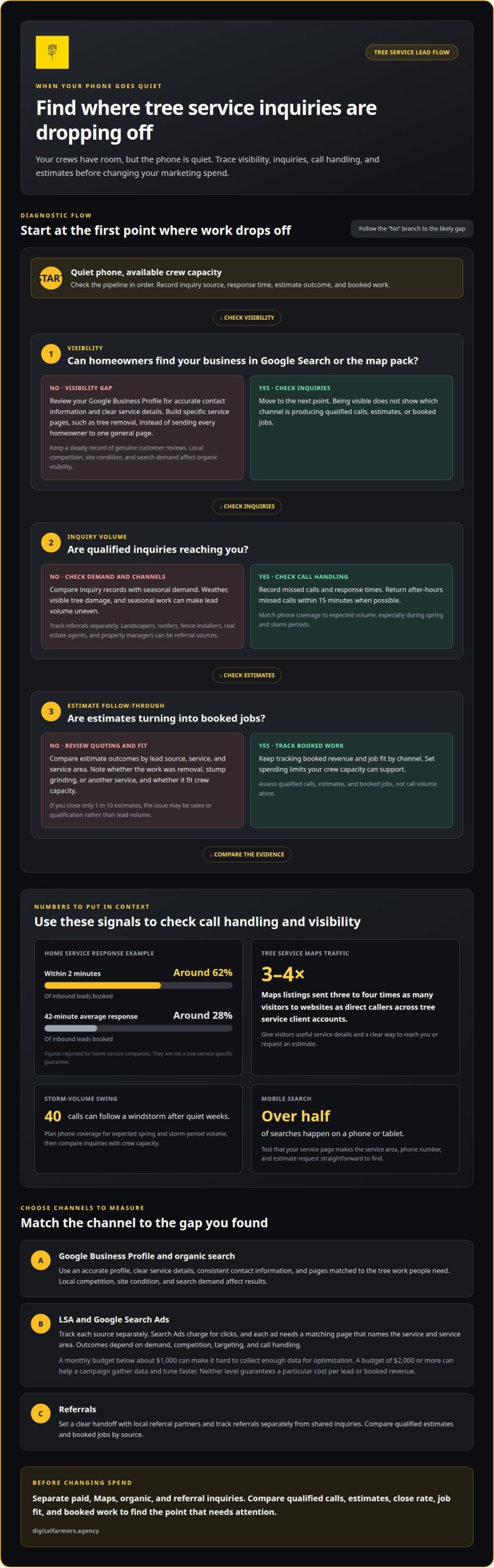
A quiet phone doesn’t prove a lead source is failing. To diagnose why tree service leads are slow, separate the pipeline into visibility, inquiries, estimates, and booked work. If homeowners can’t find you in Google Search or the map pack, focus on visibility. If inquiries come in but few estimates become jobs, review quoting and follow-up before changing channels.
Compare estimate outcomes by source, service, and service area. A company closing only 1 in 10 estimates may have a sales or qualification problem, not a shortage of leads. Note whether each estimate involved removal, stump grinding, or another service, and whether the job fit your crew capacity.
Reviews, response time, and missed calls affect conversion after homeowners find you. Home service companies responding within two minutes booked around 62% of inbound leads, compared with around 28% at a 42-minute average response time. Return after-hours missed calls within 15 minutes when possible. Record which inquiries become estimates and booked revenue.
Licensing, insurance, and local rules depend on where you work. Describe only credentials and insurance you actually hold in your advertising. Follow local requirements when making claims about permits or regulated work, since rules vary by location.
Test Local Services Ads (LSA) or Google Search Ads with inquiry records that identify each source. Track qualified calls, estimates, close rate, and booked work, not just call volume. Google Search Ads charge for clicks, so make sure the landing page names the tree work you offer, your service area, and how to request an estimate.
Set a spending limit your crew capacity can support, then assess whether inquiries fit your service area and job types. LSA and Search Ads can connect your business with people looking for tree work. Results depend on local search demand, competition, targeting, and follow-up.
Local SEO starts with an accurate Google Business Profile (GBP), clear service details, and consistent contact information. Keep your profile complete and build a steady record of genuine customer reviews to support Google Maps visibility. Make service pages specific, such as a page for tree removal, rather than sending every homeowner to one general page.
Referrals add another channel beyond paid placement. Build working relationships with landscapers, roofers, fence installers, real estate agents, and property managers. Agree on a clear handoff, such as a direct introduction, and track referrals separately from shared inquiries to see which partnerships produce qualified estimates.
Weather and local tree-care seasons affect lead volume because storms, visible damage, and seasonal work prompt homeowners to call. Tree service demand can be uneven, with quiet weeks followed by a windstorm bringing 40 calls. Staff phone coverage against the upper end of expected volume during spring and storm periods, then compare inquiry records with crew capacity.
Before shifting budgets, compare your records to understand why tree service leads are slow. A visibility gap, estimates that fail to close, too few referrals, and missed calls each need a different fix. Find where inquiries drop off, then focus on that part of the pipeline.
Google Maps, organic search, LSAs, and PPC
Understanding why tree service leads are slow starts with checking whether homeowners can find your business. Google Maps, organic search, Local Services Ads (LSA), and pay-per-click ads reach people in different ways. Maps and organic results support ongoing local visibility. Paid placements can put your company in front of active searches, depending on demand and campaign setup.
Google Maps can generate website visits as well as direct calls. Across tree service client accounts, Maps listings sent three to four times as many visitors to websites as direct callers. Give homeowners useful service details and a clear way to reach you or request an estimate.
Organic search depends on pages that match the tree work people need. A homeowner searching for crane-assisted removal should land on a page about that service, not a broad page covering every job. Local competition, site condition, and search demand all affect when organic traffic leads to qualified inquiries.
LSA and Google Search Ads can capture different types of searches. LSA places a business in a local service result, while Search Ads appear alongside relevant Google searches. Track inquiries from each source separately. If you combine paid, Maps, and organic calls in your records, you can’t tell which channel contributes qualified estimates or booked jobs.
Every search ad needs a landing page that matches its message. Name the service, define the areas you cover, and make the estimate request or phone number easy to find. Over half of searches happen on a phone or tablet, so test the page on a phone and make sure contacting you is straightforward.
Budget affects how much information a Google Search campaign can gather. A monthly budget below about $1,000 can make it hard to collect enough data for optimization. A budget of $2,000 or more can help a campaign gather data and tune faster. Neither level guarantees a particular cost per lead or booked revenue. Results depend on local demand, competition, targeting, and call handling.
No single lead source fits every tree service business. Referrals can bring trusted introductions, SEO can build organic visibility, and ads can reach people searching now. Lead marketplaces may provide shared or exclusive inquiries. Compare sources by qualified lead cost, close rate, job fit, and booked revenue, not raw inquiry volume alone.
Run a limited test before shifting your full marketing budget. Keep campaign and landing-page records separate, then track qualified calls, estimates, and booked jobs. A low cost per inquiry has little value if the caller is outside your service area or the job doesn’t fit your crews.
If you’re still asking why tree service leads are slow, check what happens between the search and the estimate. Clicks without relevant calls point to targeting or page fit. Qualified calls without booked work point to a different problem. This distinction helps you adjust the right part of the pipeline instead of replacing a channel without evidence.
Improving Google Business Profile details and service-area pages
Homeowners comparing tree companies need to know where you work and what jobs you handle. Keep your Google Business Profile (GBP) consistent with your website, including your business name, phone number, service area, and tree services. Mismatched details can confuse customers trying to request an estimate or reach your crew.
Use your profile to show the work your business actually performs. List relevant services, such as tree removal, stump grinding, and storm-damage cleanup, where applicable. Add real project photos of completed tree work, equipment, and crews. Avoid stock images that don’t represent the jobs homeowners can hire you to do.
Reviews help homeowners assess a local company before making contact. Ask customers for honest feedback after completed work, and respond to positive and critical reviews. Review count and review velocity are major factors in map pack visibility for tree service companies. A steady review process supports local visibility, but it doesn’t replace clear service details.
Build a separate website page for each major service you offer. A page about crane-assisted removal should explain that work directly, while a stump grinding page should focus on that service. This gives Google clearer information to match with relevant searches and gives homeowners a direct route to the right estimate.
Service-area pages should identify the towns or areas your crews serve and include accurate contact details. Keep the content specific to the work available there. A page for an area should explain relevant services and how homeowners can request an estimate, rather than repeat the same generic wording across every location.
Check the mobile experience. Make your phone number and estimate form easy to use on a small screen. Test it yourself: open a service page on your phone, tap the contact option, and confirm the next step is clear.
Align your GBP and service pages with your crew capacity. If you stop taking a type of work or change your service area, update the profile and related pages. This helps prevent inquiries for work you can’t schedule or locations your crews don’t cover.
Review these details alongside your lead generation records. Compare profile calls, website inquiries, estimates, and booked jobs by service and area. If your GBP gets attention but few inquiries, improve the contact path. If homeowners contact you for the wrong work, tighten service and location details before adding more pages.
Use each service-area page to make coverage and the next step clear. State the areas your crews serve and provide accurate contact details on your website. Homeowners can then see whether you work nearby and how to reach you. Keep the details aligned with your crew capacity and update them when coverage changes.
Support the page with information that helps homeowners assess your company. Show proof of insurance, real project photos, and reviews that mention safety. Describe your crews’ experience and communication clearly. These details help homeowners compare tree companies and decide whether to request an estimate.
How seasonal demand affects tree service leads in the United States
Your backlog can thin even when your crews and estimates are ready. For most U.S. tree service companies, the slow season runs from November through February. Google search volume for tree service keywords drops 35-40% during winter, so fewer homeowners may be looking for routine work.
That decline affects planning, not just marketing. Some U.S. companies report a 40-60% revenue drop during the slow season compared with peak summer months. Compare monthly inquiries, estimates, booked work, and crew capacity against your own prior seasons before treating a winter dip as a broken lead channel.
Seasonal demand varies by service area and job type. A company handling storm-damage cleanup may get calls after local weather events, while plant health care and planned pruning follow different customer needs. Separate lead records by service so a quiet period for one type of work doesn’t hide demand for another.
Tree work may follow storms, seasonal overgrowth, construction projects, insurance requirements, or visible decay. These triggers don’t arrive on a fixed calendar across every service area. Track what preceded past inquiries, then compare current calls with your service mix and local weather patterns.
Use a slower period to prepare for the next increase in demand. Review estimate follow-up, staffing, and phone coverage before spring activity builds. If crew capacity is limited, prioritize jobs that fit your equipment, service area, and backlog rather than pursuing every inquiry.
Winter outreach can support work that homeowners might otherwise postpone. Well-targeted winter direct mail campaigns generate a 0.5-0.7% response rate. Treat that range as a campaign planning reference, not a forecast for your company. Targeting, message, timing, and the homes selected all affect response.
Demand can arrive in bursts. A quiet stretch followed by a storm can bring more calls than your office can handle. Use past call records to prepare phone coverage and estimate scheduling, especially when spring demand or storm activity overlaps with a full crew calendar.
Review seasonal results by service area, not just by month. Compare the same periods in your records, then identify which services still produce qualified estimates and booked jobs. This helps distinguish a predictable seasonal slowdown from a local visibility or follow-up problem.
Seasonality changes when customers need work, but it doesn’t explain every empty week. If search activity falls while referrals and repeat customers continue, that pattern differs from a drop across every channel. Use the distinction to adjust the right part of your pipeline and protect crew capacity.
Every change in lead volume impacts your business differently. Ricky Folse with Veteran Tree Care received 10 calls in 2 days during the slow season after his first mail drop. That result makes outreach worth considering when routine demand eases, but it is one experience, not a guarantee of similar results for other companies or service areas.
Digital Farmers: Lead Generation
Digital Farmers helps tree service owners address lead generation when a quiet phone points to more than a temporary dip in demand. The work may fit when your crews have capacity but local homeowners aren’t finding you consistently. It can also help when inquiries arrive but you can’t tell which channels lead to estimates and booked work.
Start with the operating problem, not a marketing metric. If your Google Business Profile (GBP) has incomplete service details or outdated contact information, profile management can address that foundation. If your profile is visible but inquiries remain uneven, a broader lead generation approach can coordinate your channels.
Clear records still matter. Note the source of each inquiry, whether it fits your service area, whether you completed an estimate, and whether the job was booked. This gives Digital Farmers a practical basis for reviewing your pipeline instead of treating every call, form submission, or click as equally valuable.
Lead generation support is most useful when you need a clearer connection between marketing activity and crew capacity. A company with open crew days but few qualified removal estimates needs a different diagnosis from one receiving steady inquiries but carrying a full backlog. Your service mix, local search demand, and follow-up process shape the right response.
GBP management addresses the local profile homeowners may see while comparing tree companies. Accurate services, business details, and customer-facing information make that profile useful. Those updates work alongside a clear estimate path, because visibility alone won’t book a job if homeowners can’t reach you or understand what you offer.
Digital Farmers also offers AI Search. This may be relevant as tree service owners assess how customers find local companies through changing search tools. The practical goal remains the same: make your services, service area, and contact path clear, then assess whether inquiries support booked work and crew scheduling.
Outside marketing support won’t fix every slow period. If your crews are already at capacity, scheduling may be the immediate constraint, not lead generation. If most estimates fail to close, review quoting and follow-up alongside visibility. The right response depends on where qualified opportunities are being lost.
Your county and service mix affect whether profile accuracy, lead generation, or inquiry tracking deserves attention. You still need to judge job fit, backlog, and available crew hours when deciding what to change.
We invite you to schedule a market review call for your county with Digital Farmers at +1 (603) 802-6879.
Frequently Asked Questions
How long will it take to get customers?
Timing depends on your service area, starting visibility, lead channel, and follow-up. Paid campaigns can generate opportunities within the first 30 days, while Google Maps and SEO typically take 4-6 months to compound. An opportunity is not the same as a booked job. Your estimate process, close rate, and available crew capacity determine how quickly inquiries become scheduled work.
Should I get more leads or answer my phone faster first?
If you’re already getting calls but missing them, improve phone coverage before increasing lead volume. More inquiries won’t help if homeowners can’t reach you or get a clear next step. Review missed calls, callbacks, and booked work by source. If calls are consistently answered but few qualified inquiries arrive, focus on visibility or channel mix.
What causes slow lead generation for tree service companies?
Slow lead generation can result from limited local search demand, weak visibility, or a mismatch between your online service details and the work homeowners need. It can also reflect seasonal patterns or a service area that doesn’t fit your crews. Sort inquiries by source and job type to distinguish limited reach from poor-fit leads or estimates that fail to close.
How long does it typically take to get tree service leads from SEO?
Google Maps and SEO typically take 4-6 months to compound, with timing shaped by your site’s starting condition and local competition. SEO requires active, ongoing work during that period. Pages, profile details, and technical issues need attention. Judge progress by qualified organic inquiries and booked work, not by a ranking change alone.
Book a market review for your county. You’ll see search demand, who is ranking, and what your profile and site are producing right now, before anything changes. Call +1 (603) 802-6879.