
Your crews need booked work, not website traffic that never turns into calls. To improve tree service website leads, your site needs to build local trust, make it easy to request an estimate, and appear when nearby homeowners need tree work. Backlinks can support visibility when they come from relevant local organizations, publications, and home improvement or environmental sites, not unrelated pages added just to inflate link counts.
Track what each marketing channel costs per qualified lead and per booked job. A lead outside your service area, schedule, or crew capacity can still consume time and money. Clear service pages, useful job photos, customer reviews, and a simple way to call or submit a request help turn relevant visits into real opportunities.
This article explains which websites may be worth targeting for backlinks, how local trust supports visibility, and what to review across your website and marketing channels. The goal is practical: identify what can support booked work and where gaps in the lead process are costing you opportunities.
- Separate incoming inquiries from booked tree jobs so you can see which channels produce work your crews can take on.
- Build local trust through an accurate Google Business Profile, customer feedback, and a consistent presence in your service area.
- Prioritize relevant local backlinks and clear service pages over links and traffic that don’t lead to qualified calls.
- Compare marketing channels by cost per booked job, close rate, and fit with your current crew capacity.
- Review search demand, service area, and website performance together before choosing where to focus your next marketing effort.
For example, someone may request a tree removal estimate within your service area, but your crews are booked and the customer hires someone else. That’s a qualified lead you didn’t book. If the same form repeatedly attracts requests for a service you don’t offer, the page may set the wrong expectation. These are different problems and need different fixes.
Judge your website by the jobs it helps bring in, not visits alone. A clear service page, an easy contact path, and accurate expectations help the right homeowner reach you. Booked results still depend on search demand, customer decisions, and available crew capacity.
What Affects Tree Service Website Leads
A homeowner may find your tree service company on Google and still choose another company. Customer feedback, accurate listings, and clear service pages help close that gap. Each should show that you serve the area and handle the work the homeowner needs.
Feedback in neighborhood forums can reveal what local homeowners value, such as clear estimates or careful cleanup. Use recurring comments to improve your service pages and address common concerns. Local canvassing can also make your company familiar in a target neighborhood. Keep its message consistent with your website and Google Business Profile.
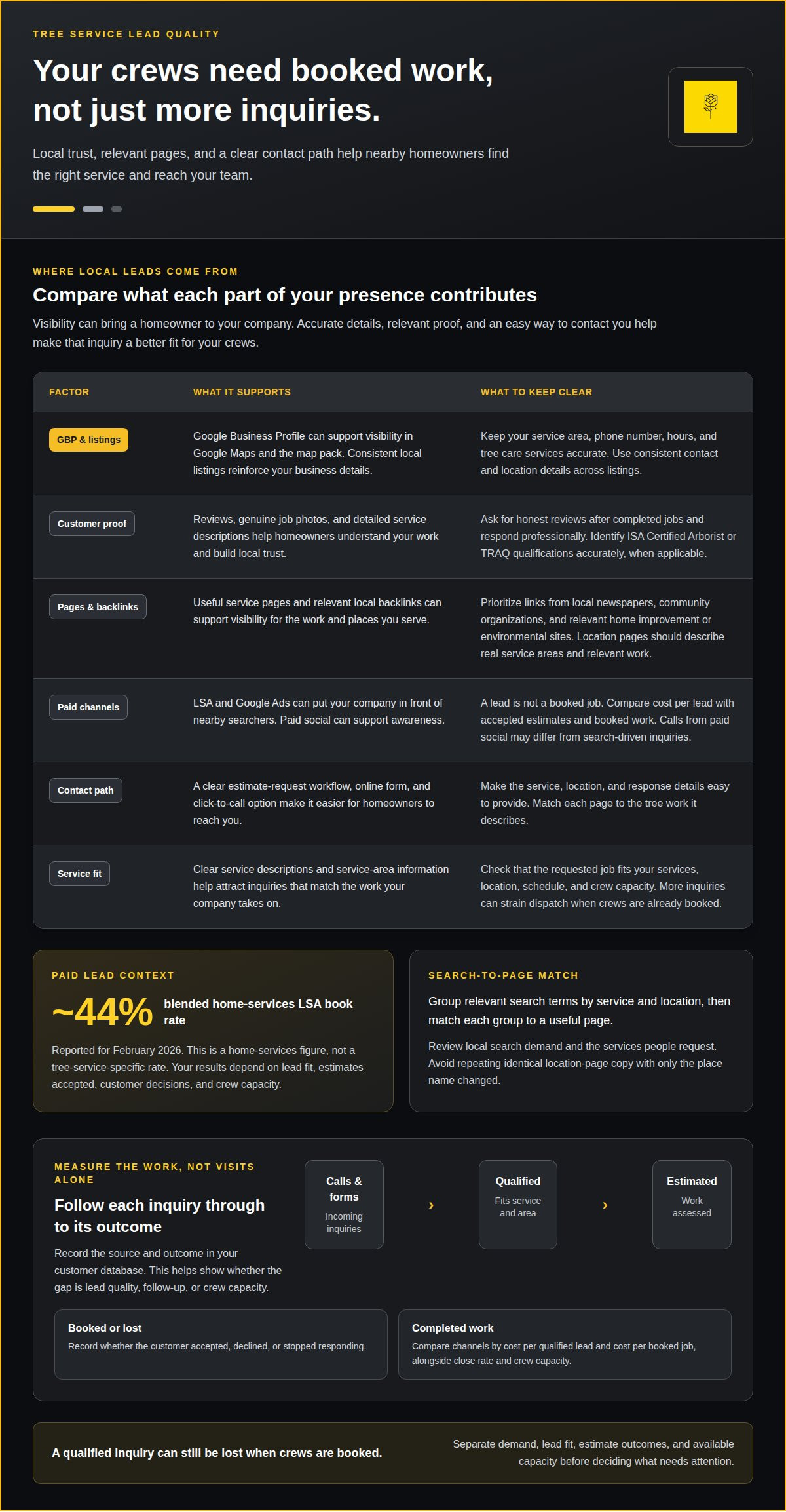
Google Business Profile, or GBP, supports visibility in Google Maps and the map pack. Keep your service area, phone number, hours, and tree care services accurate. Ask customers for honest reviews after completed jobs, then respond to feedback with a specific, professional reply. Local citations, or business listings across directories, help reinforce consistent contact and location details.
Local Services Ads (LSA) and Google Ads can put your company in front of nearby searchers, but a lead is not a booked job. The blended home-services LSA book rate was near 44% in February 2026. Track each channel’s cost per lead alongside estimates accepted and jobs booked. Paid social can support awareness, but calls from people ready to hire may differ from search-driven inquiries.
Backlinks from local newspapers, community organizations, and relevant home improvement or environmental sites can support local visibility. A link from a local source makes more sense than one from an unrelated directory. Location-specific pages should describe real service areas and relevant work, not repeat the same copy with only a place name changed.
An online quote-request form, click-to-call buttons, and a clear estimate-request workflow make it easier for customers to contact you. Ask for the service needed, job location, and a way to respond so your team can qualify the inquiry.
To identify search terms for tree removal and tree trimming, review Google search data, local search demand, and the services people request. Group relevant terms by service and location, then match each group to a useful page.
Use calls to action such as “Call for an estimate,” “Request a tree assessment,” or “Ask about stump grinding.” Match each prompt to the page’s service and make the next step clear on mobile.
Trust signals include genuine job photos, detailed service descriptions, customer reviews, and accurate credentials. If applicable, identify an ISA Certified Arborist or TRAQ qualification clearly. Don’t imply a credential applies to every crew member unless it does.
For lead generation through GBP and local listings, keep service details consistent, add relevant project photos, and connect the profile to matching location pages. These steps help Google and homeowners understand where your company works and which tree services you provide.
Steps to Improve Tree Service Website Leads
A tree removal page can attract visitors and still lose the estimate request. Improve conversion by matching the page headline, service details, and contact option to the job. For example, someone looking for stump grinding should land on a page about stump grinding, not a generic tree care page.
On-page SEO starts with one clear purpose per page. Target relevant keywords, write specific headings, and explain the work, service area, and next step. A page about crane-assisted removal should describe that service directly, not bury it beneath broad copy about every job you handle.
Backlinks support your website when they come from relevant sources. A local newspaper covering storm damage cleanup or a community organization listing participating contractors can connect your business to the area it serves. Evaluate relevance and quality, then pursue links that fit your company and service area instead of chasing unrelated placements.
Technical SEO affects whether visitors and search engines can use your site. Check mobile usability, page loading, broken links, URL structure, and unnecessary plugins. Web development teams like britecode.io prioritize speed and conversion optimization to keep prospective clients engaged from the moment they land on a page. If a phone button fails on a mobile tree removal page, a ready homeowner may leave before calling. Technical fixes should support a clear lead path, not just produce a clean report.
Common lead-losing mistakes include outdated phone details, vague service descriptions, slow pages, and forms that ask for unnecessary information. A professional checks each page on a phone and tests its call and quote-request functions. A broken form or a page that names services outside your actual work can waste both advertising spend and dispatch time.
Make the next step obvious with click-to-call buttons, a short estimate form, and service-specific prompts such as “Request a tree removal estimate.” Ask for the job location, requested service, and contact details so your team has enough information to respond and qualify the request.
Strong photos and clear proof help homeowners assess your work. Organize project images by service, such as cabling and bracing or storm damage cleanup, and pair them with concise descriptions. If your company has an ISA Certified Arborist or a TRAQ-qualified professional, identify that credential accurately.
Someone searching on a phone for tree removal in your service area should find a matching page, understand the work you offer, and see a working call button. That’s the practical aim of website design and optimization: remove friction between a qualified visitor and an inquiry. Whether collaborating with web design specialists like PurpleCow Digital or refining pages internally, results still depend on search demand, page relevance, and whether your crews can take the work.
What Results Depend On
A website can be clear, quick, and easy to use yet still produce uneven booked work. The outcome depends on demand in your market, service-area size, the cost of reaching customers, your close rate, and crew capacity. These factors affect one another. More inquiries help only when they fit your work and the schedule you can support.
Search demand determines how many nearby people look for services such as tree removal, stump grinding, or storm damage cleanup. Demand can vary by location, season, and the work homeowners need. A page targeting a service with limited local searches may attract fewer inquiries than one matching active local demand, even when both pages are well built.
Your service area shapes the pool of potential leads. A broad area may reach more customers, but travel time can reduce the value of distant jobs. A narrow area can keep crews closer to the yard while limiting relevant searches. For example, a company focused on crane-assisted removal may need different service-area priorities than one booking routine pruning nearby.
Lead cost matters, but cost per lead alone doesn’t show whether advertising works. Compare channel spend with qualified inquiries, estimates, and booked jobs. Calculate cost per booked job by dividing the marketing spend by the jobs booked through that channel. If inquiries rarely fit your service area, a low apparent lead cost may hide poor commercial value.
Close rate changes the calculation. Estimate quality, job fit, customer expectations, and follow-up all affect whether an inquiry becomes booked revenue. If you receive relevant requests but lose them after estimates, more traffic may not solve the main problem. Review the path from first call to accepted estimate and identify where prospective customers stop moving forward.
Crew capacity sets a practical limit on useful demand. If crews are booked out, extra inquiries may extend the backlog without adding work you can schedule promptly. When capacity opens up, targeted marketing for work your crews can perform may make better use of available time. Match campaigns and website priorities to current staffing, equipment, and scheduled work.
Use the same definitions across channels. Record which inquiries qualify, receive estimates, and become jobs. Then compare outcomes by service, location, and source. A tree removal campaign in one part of your area may produce a different close rate from stump grinding inquiries elsewhere. Use that comparison to adjust spending and page priorities based on booked work, not clicks alone.
Book a Market Review for Your County
Digital Farmers helps tree service companies address gaps between local visibility, website inquiries, and booked work. A targeted market review for your specific county can help if your marketing brings calls outside your service area, your website leaves customers unsure what you handle, or you can’t tell which channel produces booked jobs.
Start with the work you want more of and the areas your crews can serve. Tree removal, stump grinding, and storm damage cleanup can draw different search demand. Your available crew capacity matters too. Promoting work you can’t schedule is unlikely to improve your backlog or customer experience.
Consider how local customers find and assess your business. Google Business Profile details, service pages, customer reviews, and contact paths all shape what a homeowner sees before calling. If your profile describes one service area but your website lists another, that mismatch can confuse customers and weaken the path from search to inquiry.
Website design can address practical friction, such as a hard-to-find phone number, an overly complicated quote form, or a tree removal page that doesn’t explain the service. SEO and Google Business Profile work address visibility and the information customers see in local search. Lead generation connects those efforts to the inquiries and booked jobs you need to track.
A useful review separates problems marketing can address from operational limits it can’t solve. If the phone goes unanswered while you’re in the field, more calls alone may not create more booked jobs. If your crews are full, increasing advertising may add pressure without adding capacity. The right focus depends on where your process is losing qualified opportunities.
A company serving a defined area may receive inquiries for work outside its actual travel range. Clearer service-area information and pages aligned with the jobs and locations it wants to serve may help. If inquiries are relevant but few become estimates, examine the lead path and follow-up process before adding more traffic.
Use the call to discuss your service area, priority services, current lead sources, and available crew capacity. Bring a practical picture of which inquiries are useful, which are poor fits, and what your schedule can handle. This gives the review a business purpose beyond clicks or page views, without treating a marketing change as a guarantee.
We can discuss a tailored market review call centered on your county and service region. Call +1 (603) 802-6879 to book your market review and improve tree service website leads.
Frequently Asked Questions
What types of websites should a professional target for backlinks to a tree service website?
Look for local organizations, community publications, and established sites covering property maintenance or tree care. Relevant editorial opportunities might include sharing practical tree-care information with a gardening publication or earning a mention from a community group after supporting a local event. The link should make sense to that site’s readers. Relevance matters more than collecting links from unrelated websites.
How can a professional optimize a tree service website for local SEO?
Keep your business details, service pages, and Google Business Profile consistent so they present an accurate picture of your work and coverage. Review search terms used in your market and organize pages around real services rather than relying on one catch-all page. The content should reflect your actual service area and give customers a clear way to call or request an estimate.
How can tree service companies track website leads and marketing ROI?
Track calls and form submissions by their original source, then record whether each inquiry became an estimate and a booked job. Compare marketing spend with booked jobs for each channel, separating qualified leads from requests you can’t serve. This helps show whether a change is producing useful work or simply adding activity. Keep tracking categories consistent so you can compare results over time.
Book a market review call for your county. Call +1 (603) 802-6879.