

Your crews are working, but the schedule ahead is uneven. A tree service marketing plan template for 2026 should connect the jobs you want to book with the channels that can reach those customers, not just list marketing tasks.
You already know that more calls are not automatically better. The right work depends on your service area, crew capacity, close rate, and the jobs that keep your backlog moving without overloading the schedule.
Use this guide to build a plan around operating goals. You’ll connect goals to channels, review local competition, set a workable budget, and track how SEO, advertising, direct mail, and your Google Business Profile contribute to booked work. You’ll also get a practical template for turning customer feedback and job demand into clear next steps. The goal is a working tool for decisions, not a document that sits on a shelf.
Key Takeaways
- Set marketing goals around the work your crews can take on, not call volume alone.
- Assess GBP, customer reviews, and channel performance by their contribution to qualified calls and booked revenue.
- Build a usable plan by assigning channel budgets, staff time, and measures to track.
- Account for service area, search demand, close rate, and available crew capacity when setting expectations.
- Use a county-level market review to identify which channels fit your local demand and operating capacity.
Marketing Plan Goals Tied to Your Crew Capacity
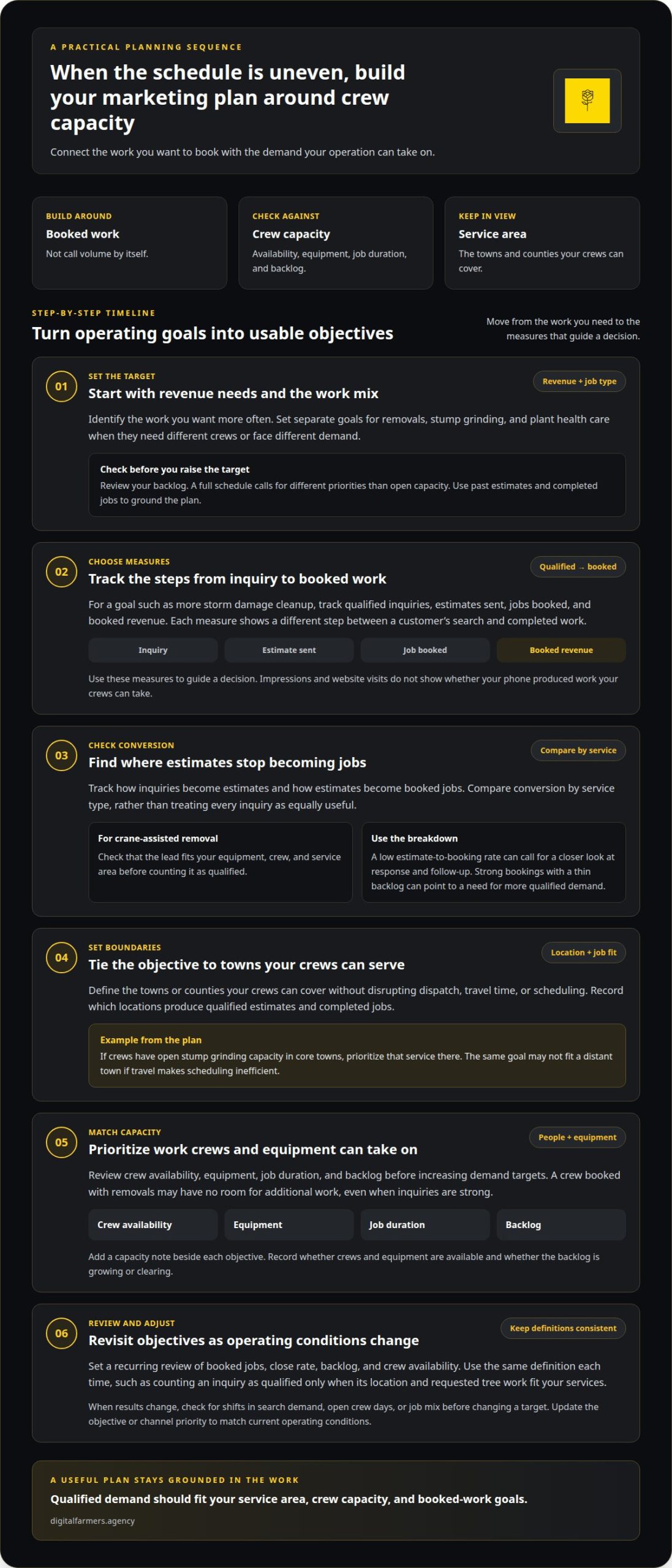
A marketing target matters only when it supports work your crews can complete. Build each objective around booked jobs, available capacity, and the service area you can cover.
Set Revenue Targets and Growth Goals
Start with the revenue your business needs, then identify the work you want more often. Set separate goals for removals, stump grinding, and plant health care if they require different crews or face different demand. Check your backlog before setting growth targets. A full schedule calls for different marketing priorities than open capacity.
Use past estimates and completed jobs to ground your plan. If larger removals support your revenue goal but require specialized equipment or scheduling, include those limits in the objective. Don’t treat a revenue target as a marketing promise. Demand, close rate, job mix, and crew availability all affect what gets booked.
Choose Measurable Objectives and KPIs
Make each growth goal measurable against actual work. If you want more storm damage cleanup jobs, track qualified inquiries, estimates sent, jobs booked, and booked revenue for that service. Each measure shows a different step between a customer’s search and completed work.
Choose KPIs that guide a decision. If inquiries rise but bookings do not, review estimate follow-up and close rate. If bookings are strong but crews are committed, more calls may strain scheduling rather than improve revenue. Don’t use impressions or website visits as your main objective. They don’t show whether your phone produced work your crews can take.
- Connect objectives to conversion. Track how inquiries become estimates and estimates become booked jobs. For crane-assisted removal, check whether the lead fits your equipment, crew, and service area before counting it as qualified. Compare conversion by service type, not just across the business. This helps separate useful demand from inquiries that cannot become scheduled work.
Use the results to find where the process breaks down. A low estimate-to-booking rate may call for a closer look at response and follow-up. A high booking rate with a thin backlog may point to a need for more qualified demand. Tie each measure to a practical decision, such as changing which job types you prioritize.
- Set service-area boundaries. Define the towns or counties your crews can cover without disrupting dispatch, travel time, or scheduling. Then connect objectives to the work available in those locations. A campaign that attracts inquiries outside your workable service area can raise lead volume without increasing booked revenue.
For example, if your crews have open stump grinding capacity in core towns, prioritize that service there. The same goal may not make sense in a distant town if travel would make scheduling inefficient. Include geography in the objective, and record which locations produce qualified estimates and completed jobs.
- Match targets to crew capacity. Review crew availability, equipment, job duration, and backlog before raising demand targets. A crew booked with removals may have no room for additional work, even when inquiries are strong. Assign objectives to service lines that can take on new jobs without putting pressure on scheduling.
Add a simple capacity note beside each objective. Record whether crews and equipment are available and whether the backlog is growing or clearing. Update marketing priorities when capacity changes. The goal is not maximum call volume. It is qualified work that fits your operation and supports booked revenue.
- Schedule regular objective reviews. Set a recurring review and compare each objective with booked jobs, close rate, backlog, and crew availability. Use consistent definitions each time. For example, count a lead as qualified only if its location and requested tree work fit your services.
When results change, identify the cause before adjusting the target. Seasonal shifts in search demand, fewer open crew days, or a different job mix can affect performance. Update the objective or channel priority to match operating conditions. Keep the plan grounded in completed work, not surface-level activity.
What Your Current Channels Are Producing
Your phone can ring without producing the right jobs. Trace each channel from local search or referral to qualified estimate, booked work, cost per lead, and revenue.
- Review your GBP activity. Check that your Google Business Profile accurately lists your tree services and service areas. Add job photos, respond to reviews, and post relevant updates. Compare GBP calls and estimate requests with work actually booked, not profile views alone.
- Assess customer reviews. Look for recurring details customers mention, such as clear estimates, careful cleanup, or good communication. Ask customers for honest feedback after completed work, and never fabricate or buy reviews. Use common themes to understand what matters to homeowners choosing tree removal, pruning, or stump grinding.
- Handle advertising and customer information responsibly. Describe your services accurately, request genuine reviews, and protect names, phone numbers, and job-site details. Avoid unsupported claims about credentials or outcomes, and don’t publish identifiable customer information without permission.
- Define the customers you want to reach. Group inquiries by service, location, and job fit. A homeowner seeking a routine pruning estimate has different needs from someone requesting storm damage cleanup or crane-assisted removal. Record which groups produce qualified estimates and booked revenue, then focus campaigns on customers your crews can serve.
- Study competing local businesses. Review tree service companies appearing in search results for your service area. Note the services they emphasize, whether their profiles feature recent job photos, and how they respond to reviews. Use these observations to find gaps in your own content or customer communication, not to copy another company’s claims.
- Prioritize channels by actual performance. Local tree service channels can include GBP, organic search, paid advertising, referrals, and direct mail. The right mix depends on local demand, your service area, and whether each channel brings qualified calls at a workable cost per lead. As growth marketing specialists like Peter Montoya emphasize, achieving measurable scaling requires focusing on channels that drive real business outcomes rather than vanity metrics. Track channels separately before shifting budget or staff time.
- Match lead generation to the service. For tree removal and pruning, make service information easy to find, show relevant job photos, request customer reviews, and track estimate requests by channel. Shared lead platforms can bring inquiries that are poorly matched to your area or costly relative to booked revenue. Compare their actual close rate and job fit with channels where you build direct customer awareness.
- Use a consistent review structure. In your campaign calendar, record the channel, inquiry source, requested service, estimate outcome, cost per lead, and booked revenue. Review these fields together. A channel that builds awareness but produces few suitable estimates needs a different response from one that brings profitable, schedulable work.
Build a Marketing Plan You Can Use
Set your budget around booked-work goals, crew capacity, and channel performance, not a borrowed percentage. PPC and lead-platform costs vary with service area, competition, campaign setup, and pricing model. Assess lead cost alongside close rate and booked revenue.
Plan the Marketing Budget and Resources
First, record the marketing budget your business can support without squeezing payroll, equipment, or operating cash. Then assign staff time to answer calls, return estimate requests, gather job photos, and track outcomes. A campaign that generates inquiries without anyone available to respond is a poor use of budget. Note delivery capacity beside the budget in the same plan.
Allocate Budget Across Marketing Activities
Choose channels based on your target customers, local demand, and the work your crews can take. Give each activity a purpose, owner, budget, and review date. For example, direct mail and door-to-door distribution—such as services offered by LeafletPro UK—may build awareness in selected neighborhoods, while paid search can address active demand for removals. Don’t borrow restaurant budget benchmarks for a tree service. The audience, buying cycle, and job economics differ.
Measure Performance, Costs, and Conversions
Track each channel’s spend, qualified inquiries, estimates, booked jobs, and revenue in one framework. Compare channel spending with inquiries that fit your service and location requirements to assess lead costs. Then track conversion from qualified inquiry to estimate and from estimate to booked job. Don’t judge lead pricing by volume alone. Job fit, close rate, and delivery capacity all affect value.
- Build a working template. Create sections for business goals, target services, service area, audience, channel strategy, budget, staff owner, KPI, and review date. Add a status for each activity, such as planned, active, or paused. This gives the plan direction and makes responsibilities clear. Keep the template concise enough to update during normal operations.
- Put the plan on a calendar. Schedule campaign launches, review requests, direct mail drops, and performance checks. Assign each activity to a staff member so field crews aren’t left managing marketing during job hours. A seasonal schedule can place storm damage messaging when that service fits your operation, while pruning content follows your actual workload and local demand.
- Review results and adjust the plan. Schedule a monthly review of budget, cost per lead, close rate, booked revenue, and crew capacity. If a channel brings inquiries from outside your service area, narrow its focus. If the backlog is full, pause demand-building activities or shift attention to services with available capacity. Record each change and its reason so the next review reflects actual performance.
What Your Results Depend On
Marketing does not control every part of booked revenue. Results depend on how local demand, your service area, budget, close rate, and crew capacity align.
Service area shapes opportunity. A company serving a spread-out rural county faces different travel and scheduling demands from one serving a dense group of towns. Inquiries from places your crews cannot reach efficiently can increase lead volume without adding useful bookings. Set geographic priorities around dispatch, travel, and the jobs your operation can complete.
Search demand affects the available pool of customers. The number and type of people searching for tree removal, pruning, or storm damage cleanup vary by location and season. Marketing can help your business appear to relevant customers, but it cannot create local demand where little exists. Match each channel and message to the tree work customers are seeking.
Budget affects reach and consistency. A limited budget may mean focusing on channels that already produce qualified inquiries. Spreading funds across every option can leave each campaign without enough support to assess its contribution. Compare cost per lead with booked revenue and job fit, then adjust spending based on actual performance.
Close rate connects inquiries to booked work. An inquiry produces revenue only when it fits your services, receives an estimate, and converts into a scheduled job. Call handling, estimate clarity, and follow-up can affect conversion even when marketing brings attention. Track each stage separately to see where prospects stop moving forward.
Crew capacity sets the practical ceiling. Open schedule space, equipment availability, and crew skills determine which jobs you can accept. If removal crews are booked but pruning capacity is open, promoting pruning may make more sense than generating more removal inquiries. Tie channel priorities to the work your operation can take.
Imagine your company starts spring with limited pruning bookings and crews available for that work. You can promote the service in nearby areas where travel fits the schedule, then track whether inquiries become estimates and booked jobs. If removal work fills the backlog, shift priorities to match the new capacity.
Search demand and customer behavior can also change as people use AI tools to find local services. AI Search may be one part of your channel mix, alongside established options. A county market review can help relate channel choices to local demand and the work your crews can handle.
Book a Market Review for Your County
Digital Farmers helps tree service owners connect marketing decisions to conditions in their service area. A market review brings local search demand, competing businesses, and your current online presence into one practical view. It helps identify where your plan fits the market and where it needs adjustment.
Bring your operating picture into the review. The jobs you want, your service area, and your crews’ available capacity all affect which marketing activities make sense. Your plan should reflect those limits instead of treating every inquiry as equally useful.
Digital Farmers provides SEO, lead generation, Google Business Profile management, and AI Search. These services address different ways customers may find a tree service business. Their role in your plan depends on what you need to improve, local demand, and how your business handles inquiries.
A useful review looks beyond whether a channel is active. It checks whether the information customers see matches the work you perform and whether inquiries fit your service area. It can also reveal gaps in your records between initial contact and booked work.
For example, if customers find your company but ask about services you do not prioritize, make your service information clearer. If inquiries fit your work but come from areas your crews cannot cover efficiently, your targeting may need adjustment. The right response depends on what the review shows and how your operation is set up.
The review should give you a clearer basis for your next planning decision. You can decide whether to refine an existing channel, adjust the services or areas you emphasize, or use another way to reach local customers. Account for the work your crews can complete and the information customers need before they contact you.
If you want to assess your county before making changes, book a market review call. Call +1 (603) 802-6879 to discuss your tree service marketing plan with Digital Farmers.
Put the Plan to Work in Your County
A plan earns its place when it helps you make sound decisions during a busy week. Keep your tree service marketing plan template for 2026 useful by updating it when crew availability, service demand, or your backlog changes.
Digital Farmers supports tree service businesses with SEO, lead generation, and Google Business Profile management. The right mix depends on your service area, the work you want to book, and your crews’ capacity.
Keep your plan grounded in those operating conditions. Clear priorities make it easier to adjust marketing while staying focused on the work your business can deliver.
Frequently Asked Questions
How do you turn the plan into action this week?
Choose one service and one marketing task to start with. For example, assign someone to add recent pruning photos to your Google Business Profile, then record related calls and estimate requests. Give the task an owner and due date. Keep the first work session focused on what your team can complete alongside active jobs.
What should a 2026 tree service marketing plan template include?
Include your business goals, priority services, service area, target customers, channel choices, budget, staff responsibilities, and performance measures. Add fields for planned work and notes on results or changes. For example, a storm damage campaign should identify its target locations, who handles inquiries, and how you’ll record qualified estimates and booked jobs.
How can tree services improve local SEO and Google Business Profile rankings?
Keep your Google Business Profile accurate and active. List the services you perform and areas you serve, add genuine job photos, respond to customer reviews, and post relevant updates. On your website, provide clear information for services such as removals, pruning, and stump grinding. Track calls and estimate requests because profile activity alone does not show booked work.
What seasonal marketing campaigns should tree services run throughout the year?
Build campaigns around the services customers need and the work your crews can take. Promote storm damage cleanup when severe weather creates relevant demand, and feature pruning or plant health care when those jobs fit your schedule. Use job photos and service-specific information instead of generic seasonal messages. Adjust campaigns as your backlog changes so promotion reflects available capacity.
How can a tree service marketing plan target nearby cities and service areas?
Start with places your crews can serve efficiently based on travel, dispatch, and the jobs you want. Create useful website information for each service area, with accurate services, local job examples, and a clear way to request an estimate. Don’t add locations your business does not serve. Track inquiry locations and booked work to see which areas fit your operation.
What metrics and KPIs should a tree service marketing plan track?
Track qualified inquiries, estimates sent, close rate, booked jobs, booked revenue, cost per lead, and the service area for each inquiry. Add the requested work type and whether the job fit your crew and equipment. Use these measures to spot where prospects drop out and where marketing produces suitable work.
How much should a tree service company budget for marketing in 2026?
Set your budget around booked-work goals, crew capacity, and channel performance rather than a borrowed percentage. Keep it within what your business can support without squeezing payroll, equipment, or operating cash. Book a market review call for your county to see search demand, who is ranking, and what your profile and site are producing right now. Call +1 (603) 802-6879.