

Your crews may be booked in one area while homeowners nearby still can’t find your company. Tree service marketing by service area focuses your listings, website, and advertising on places your crews can serve. The goal is not more calls from everywhere. It’s qualified inquiries for work your team can take on.
Location affects which jobs make sense for your business. Travel time, crew capacity, equipment, and job type all shape where you can work. Your marketing should reflect those limits so you spend less time responding to inquiries that don’t fit your schedule or service area.
This article covers how to improve your local visibility, create useful area-specific pages, promote your services near completed jobs, and target paid campaigns. Measure each channel by the qualified calls, estimates, and booked jobs it produces, alongside your crews’ capacity.
Key Takeaways
- Keep your local listings accurate and consistent so nearby customers can find the right services and contact details.
- Set your Google Business Profile service area to match where your crews can realistically take jobs.
- Build useful pages for the communities you serve, with details on local services rather than repeated city names.
- Use trucks, job-site signs, and local sponsorships to make your work visible in the neighborhoods you want to reach.
- Judge paid ads by qualified calls, booked work, and crew capacity, not clicks alone.
1. Local directory listings
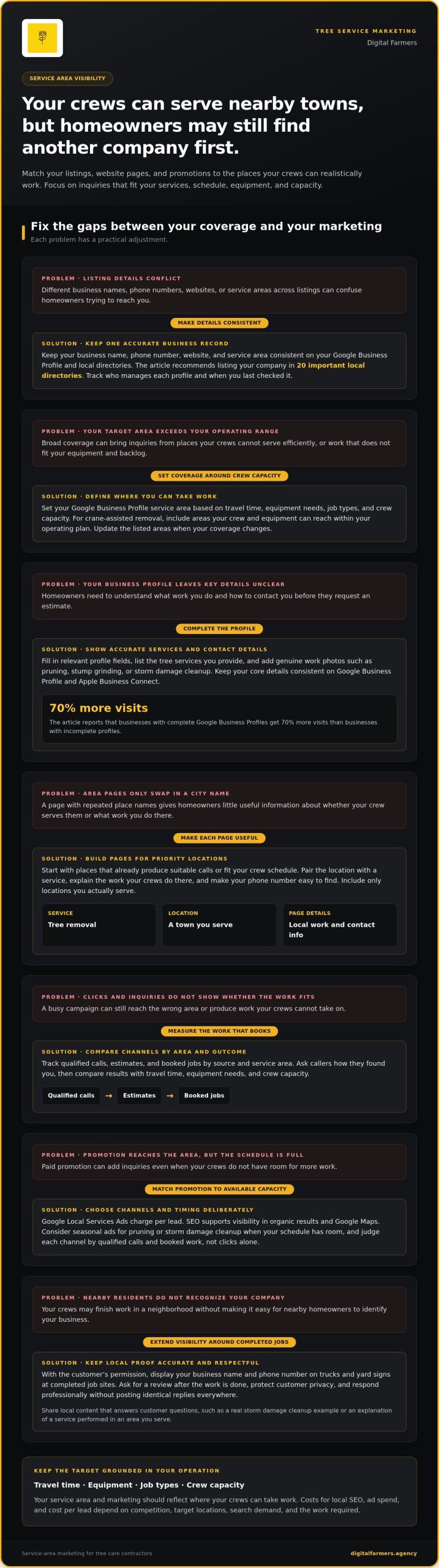
Your crews finish a removal, but the next nearby homeowner may find another company first. Tree service marketing by service area starts with accurate listings in the places your crews can serve. Begin with your Google Business Profile, then check that your business name, phone number, website, and service area match across local directories. Tree service businesses are advised to list their companies in 20 important local directories. Keep each listing consistent, not a separate ad with conflicting details.
Reviews help homeowners decide whom to call for tree removal or stump grinding. Ask customers for a review after completing a job, while the experience is fresh. Respond with a professional reply that references the service when appropriate. Protect customer privacy and avoid posting identical responses everywhere.
Compare local search results with the work you can take on. Search Google Maps for the tree services you provide, and note which businesses appear and what their profiles say. Compare those results with your calls and booked jobs by area. Then factor in travel time, equipment needs, and crew capacity. A competitive area may still be a good fit, while distant inquiries may not be practical to serve.
Local content should answer customer questions, not just repeat place names. Share a real example, such as how your crew handled storm damage cleanup, or explain a service you performed in an area you serve. Mention the relevant service and location, then share the page on social media. Track calls and booked jobs to see whether the content brings useful inquiries.
Google Local Services Ads can connect your business with people searching for local services and charge per lead. SEO supports visibility in organic results and Google Maps. Tree service marketing by service area is most useful when your target locations match your crews’ coverage and your profile and website accurately describe your services. Run seasonal ads for services such as pruning or storm damage cleanup when your schedule has room.
Local SEO costs depend on competition, the number of areas you target, and the work required on your website and profile. Ad spend and cost per lead also vary with targeting, search demand, and the services promoted.
Keep offline details consistent with your online listings. With the customer’s permission, display your business name and phone number on trucks and yard signs at completed job sites. Ask callers how they found you, then compare inquiries and booked work by source and area. This helps you see whether a listing or neighborhood promotion brings in work that suits your crews.
2. Why Does Tree Service Marketing Matter for Your Business?
Your trucks may work across several towns, but your Google Business Profile needs a clear service area. A profile helps connect your tree service business with local searches for work you actually take. Businesses with complete Google Business Profiles get 70% more visits than businesses with incomplete profiles. Complete the profile before expanding promotion into another town.
Define your service area by travel time, equipment needs, job types, and crew capacity. Prioritize places where you can schedule work efficiently and inquiries fit your backlog. For crane-assisted removal, for example, target areas your crew and equipment can reach within your operating plan.
Set your Google Business Profile service-area details to reflect where you perform work, not every place from which someone might request it. Update the areas listed when your operating range changes. Broad targeting can bring inquiries your crews cannot serve; focused coverage keeps your marketing aligned with the work you can book.
Complete relevant profile fields with accurate business details and the tree services you provide. Keep your business name, phone number, and website consistent across listings. Add genuine photos of your work, such as pruning, stump grinding, or storm damage cleanup. Clear, accurate information helps customers understand what services to call about.
Google Business Profile is one local listing to maintain. Apple Business Connect is another place to manage how your business appears across Apple services. Keep your core details consistent across both, and update them when your phone number, website, or service area changes. Inconsistent information can confuse homeowners trying to request an estimate.
Citation management means keeping your business information accurate across directories and local listings. Maintain a simple record of each profile, who manages its login, and when you last checked its details. Update listings after a move or service-area change. Then compare calls and booked jobs by area, not just profile views, to decide where to focus.
Your profile should match your field operation. If your crews stop taking work in a distant town, remove it from the target area and adjust campaigns that still reach it. If you need help maintaining a Google Business Profile for your service area, focus the work on accurate details, relevant service information, and calls that fit crew capacity.
3. Creating separate website pages for each service area
Homeowners searching for tree removal need to know whether your crew serves their area. Create a page for each priority location your team can reach and work in. Pair the location with a service, such as tree removal in a nearby city. Explain what your crews do there and how customers can request an estimate.
Start with areas that already produce suitable calls or fit your crew schedule. Give each page a clear title, an accurate description of the area, and an easy-to-find phone number. Explain the relevant work, such as pruning, stump grinding, or storm damage cleanup. Don’t list a location just because it’s nearby if you don’t serve it.
Listing areas your crews don’t serve can mislead customers. Pages that only swap one city name for another give readers little useful information. Keep your coverage accurate, and make every location page relevant to customers in that area.
A useful page answers practical questions before the phone call. Describe the services available, the tree work your crews perform, and how customers can request an estimate. Include genuine job photos and explain relevant site considerations, such as equipment access or a limited drop zone, when they reflect your actual work.
Make each page specific without claiming local experience you can’t support. Describe the areas your crews cover and the services available in each one. Don’t say you handled a local storm or worked in a neighborhood unless your records support it. Accurate details help customers decide whether your company fits their needs.
Blog posts can support area pages when they address real customer concerns. Describe a completed pruning job, explain what homeowners should consider before tree removal, or discuss how your crew assesses storm damage. Link the post to the relevant service-area page, and share it on social media when it’s useful to customers you serve.
Review each page against the work you want to book. If you want more emergency tree calls, make that service clear in the areas you serve and explain how customers can contact you. If a page brings inquiries from outside your coverage, clarify its location details. Track calls and booked jobs by page to see whether inquiries fit your crew capacity.
Build pages to help customers, not to fill a map with place names. A focused page for an area you genuinely serve gives searchers useful information and can bring in more relevant inquiries. Update it when your services, crews, or operating range changes.
4. Neighborhood visibility through trucks, yard signs, and sponsorships
After a pruning job, your crew may drive through the same neighborhood to the next site. That gives nearby homeowners a chance to notice your company. Treat truck graphics, job-site signs, door hangers, and local sponsorships as one neighborhood marketing plan, focused on areas your crews serve.
Vehicle graphics can generate 30,000–70,000 daily impressions. Keep the business name, phone number, and core service easy to read. Tree service truck graphics should be legible from 50 feet away while moving at 35 miles per hour. A crowded design makes it harder for homeowners to remember who handled the tree removal down the street.
Yard signs work closest to completed jobs. Place a sign where neighbors can see it, with the customer’s permission, and include a clear phone number and service name. An 18-by-24-inch sign gives room for readable information without turning the lawn into a billboard. Remove signs when the job ends or the customer asks.
Use door hangers to extend your visibility to nearby homes after a job. Keep the message relevant to the work and neighborhood. For example, after pruning, a hanger can describe your pruning services and the areas you serve. Include a way to identify calls from the distribution, then track inquiries and booked work separately.
Seasonal campaigns can connect a specific service with a local audience. One suggested social media offer is 10% off fall tree trimming for homeowners in a target ZIP code. Use that only when the promotion fits your margins, schedule, and crew capacity. A discount that fills the calendar with low-margin work does not improve booked revenue.
Sponsorships can keep your business visible in a community beyond active job sites. Choose a local team, event, or neighborhood group whose audience overlaps with your service area. Make your business name and contact details easy to find, then record calls that mention the sponsorship. Without a way to track inquiries, it’s difficult to compare sponsorships with other channels.
Keep offline messages consistent with your online listings. The phone number on your truck should match the number on your profile. If a yard sign promotes pruning, the related page or profile should explain that service. Consistent details make it easier for customers to go from seeing your work to contacting you.
Review results by area, service, and booked job. If signs near a pruning project bring relevant calls, repeat the placement where your crews work. If door hangers bring inquiries from outside your service area, narrow the distribution. Local visibility is useful when it leads to work your crews can schedule.
5. Paid advertising and lead generation
Paid advertising can bring in calls when organic visibility is limited or your crews have room. It can also spend budget on jobs you can’t take. Target your actual service area, and match each ad to a service such as tree removal, pruning, or storm damage cleanup.
Separate campaigns by service and location. Someone seeking emergency tree work has different needs from a homeowner planning routine pruning. Send each ad to a page that explains the matching service and makes calling easy. Review search terms and location reports, then remove irrelevant searches or areas.
Measure the pipeline beyond ad clicks. Record each call’s source, whether the job fits your service area, whether you provided an estimate, and whether it became booked work. Compare cost per lead with your close rate and booked revenue. A low cost per lead isn’t useful if inquiries come from outside your territory or the jobs exceed crew capacity.
Google Ads can reach people actively searching for tree work. Local Services Ads can also appear for local service searches and charge per lead. Track the channels separately because their costs and call quality can differ. Set a practical budget based on market demand, competition, and the work you can schedule.
Bing Ads can be tested as an additional search channel. Limit targeting to areas you serve and compare qualified calls with your other campaigns. Nextdoor ads can support neighborhood promotion, especially when you have a relevant service or completed job to discuss. Track each channel separately before shifting more budget to it.
Not every channel deserves ongoing spend. Avoid broad campaigns that reach distant towns, generic ads that don’t name the tree service, and placements that report clicks without useful call details. Both total $300, but the example’s different close rates produce different job counts. Your own close rate and job value determine whether a lead source works.
Base seasonal advertising on your actual schedule. Promote pruning when you have room for the work, and storm damage cleanup when crews and equipment can respond. Pause or narrow campaigns when your backlog is full. This keeps spending aligned with your capacity instead of generating calls your office can’t turn into scheduled jobs.
If you want help aligning paid campaigns with service areas and crew capacity, review service-area advertising as part of your lead-generation plan.
Digital Farmers: SEO
Digital Farmers supports tree service companies with Local SEO, Google Ads, Local Services Ads, Google Business Profile optimization, website design, and other marketing services. The work can connect search activity with your service areas and the jobs you want to book. Measure success by whether inquiries fit your coverage, close rate, and crew capacity.
The right marketing plan depends on your current visibility, local search demand, and the work your crews can take on. Use those operating facts to decide whether outside support fits your next step.
Set your local growth plan around crew capacity
Set marketing priorities around the work your crews can take on and the areas you serve. A clear operating target helps you focus on relevant opportunities without adding calls that strain your schedule.
Use booked jobs and crew capacity to guide adjustments. Keep your plan focused on work your team can deliver, and adapt it as your operating needs change.
That gives your marketing a practical purpose: supporting the work you want to book and the crews ready to handle it.
Frequently Asked Questions
Why Does Tree Service Marketing Matter for Your Business?
A clear target connects available crew capacity with customers seeking tree work in areas you serve. Without one, you may spend time handling calls for distant jobs or services you don’t offer. Track inquiries through estimates and booked work. That gives you a practical basis for deciding whether a channel supports your schedule and preferred job mix.
What Tree Service Advertising Ideas Are Worth Paying For?
Choose channels that can reach customers looking for work you can take on. Search ads can capture active demand, while direct mail can promote a specific service to nearby homeowners. Test a focused campaign and track qualified calls, estimates, and booked jobs. Judge it by whether the work fits your costs and schedule, not just by how many people saw the ad.
How can tree services optimize Google Business Profile for multiple service areas?
Keep your profile accurate and aligned with the work your crews can perform. Review the business details, service descriptions, contact information, and service-area settings whenever your operating range changes. For help with the profile and its role in local visibility, Digital Farmers provides Google Business Profile support. Measure inquiries by service area so your targeting reflects real jobs, not assumptions about where demand exists.
Should a tree service create separate location pages for each city it serves?
Create a location page when you can provide useful information to customers in that area. Explain available services, how to request an estimate, and what details help your team assess a job. Avoid pages that only replace one city name with another. Thin duplicate pages add maintenance without giving customers a meaningful reason to visit.
What should tree service area landing pages include to rank in local search?
Give each page a clear service and location focus, then answer practical customer questions. Include accurate service coverage, relevant work details, a clear way to contact you, and genuine photos from completed jobs. Make the page easy to use on a phone. Keep claims specific to your experience, and update the page when your services or coverage changes.
How can tree services find local keywords and search demand by service area?
Use the words customers use on calls and estimate requests, then compare them with queries in Google Search Console. Group phrases by service and location, such as pruning in an area you serve. Match those phrases to relevant pages and track which pages produce qualified inquiries. Search activity matters when it aligns with your close rate, job value, and crew capacity.
How should tree services target neighborhoods with direct mail, yard signs, and local partnerships?
Focus on areas near completed jobs or where crews have room for more work. Match each message to a relevant service, then record which calls came from mail, signs, or a local partnership. For example, distribute a pruning message near a completed pruning job. Compare estimates and booked work before repeating the approach elsewhere.
What are Google’s rules for service-area businesses and virtual offices?
Use Google’s current guidance before changing an address, service area, or profile setup. Its business representation guidelines explain how businesses should represent themselves on Google. Avoid assumptions based on another company’s setup. Review the guidance against your actual business operations, then keep the profile details consistent with how customers can reach and work with your company.