

Your phone can go quiet just as a crew opens up, then ring while you’re running a job and can’t answer. Seasonal demand shifts, but payroll and equipment costs keep moving. To get more tree service calls, you need visibility among people in your service area and a process that turns inquiries into estimates and booked work.
More calls alone won’t fix an empty schedule if they’re outside your area, don’t match your services, or go unanswered. Track which inquiries become estimates, which estimates close, and how much work your crews can take on.
This article covers how to connect search visibility, call handling, and follow-up. Focus on high-intent searches, track calls through to booked jobs, and adjust marketing to fit crew capacity instead of chasing activity that doesn’t fill the schedule.
Key Takeaways
- Track each stage from search visibility to completed work to find where qualified jobs are dropping out.
- Use Google Maps, Local SEO, Google Ads, and Local Services Ads based on local demand and the work your crews can take on.
- Make your phone number, service area, and tree care services clear on mobile so nearby customers can contact you.
- Record every inquiry, set a follow-up step, and track estimate outcomes to see which calls turn into booked work.
- Find the weakest point in your call pipeline before replacing marketing work that may still be producing value.
Start by finding where tree service calls are being lost
Your crews have room for more work, but the phone isn’t producing enough qualified jobs. Before adding advertising or replacing a website, find where the current path breaks. More visibility won’t fix missed calls, and more calls won’t help if they don’t fit your service area or crew capacity.
Track the sequence from search impressions to website visits, calls, estimates, booked jobs, and completed work. Each stage answers a different question. Impressions show whether people see your business, calls show whether they take action, and estimate and booking records show whether those inquiries can become work your crews perform.
The gap may be visibility, caller fit, missed calls, weak follow-up, or a full schedule. Record each inquiry’s source and outcome before changing channels. Otherwise, you won’t know whether a new campaign fixed the problem or simply added activity.
Track the path from inquiry to booked job
Use a customer database or CRM to record the inquiry source, requested service, response, estimate status, and booking outcome. Keep the record short enough to update between jobs. A consistent entry is more useful than a complicated form that no one completes.
Separate qualified work, such as tree removal or storm damage cleanup within your service area, from unrelated requests. This shows which sources bring callers who fit your operation, not just which ones generate activity.
For each inquiry, note whether you reached the caller, arranged an estimate, sent an estimate, booked the job, or closed the record without work. Review those outcomes by source to understand your close rate and booked work.
Check crew capacity before increasing call volume
Compare available crew days with the work already scheduled. Then identify the services and job types that fit your equipment, crew skills, and backlog. Crane-assisted removal may need a different setup than stump grinding, so the most useful inquiry is one your operation can take on and schedule sensibly.
Set a response process you can maintain while running jobs. Decide who records inquiries, how callers get an update, and when an estimate needs follow-up. If you’re often in the cab or on a job site, make the process simple enough for another team member to handle.
Once you have consistent records, the next move becomes clearer. If qualified callers aren’t finding you, address visibility. If calls are missed or estimates stall, fix the handling and follow-up first. That diagnosis helps you get more tree service calls without adding demand your crews can’t serve.
Capture high-intent tree service searches across the right channels
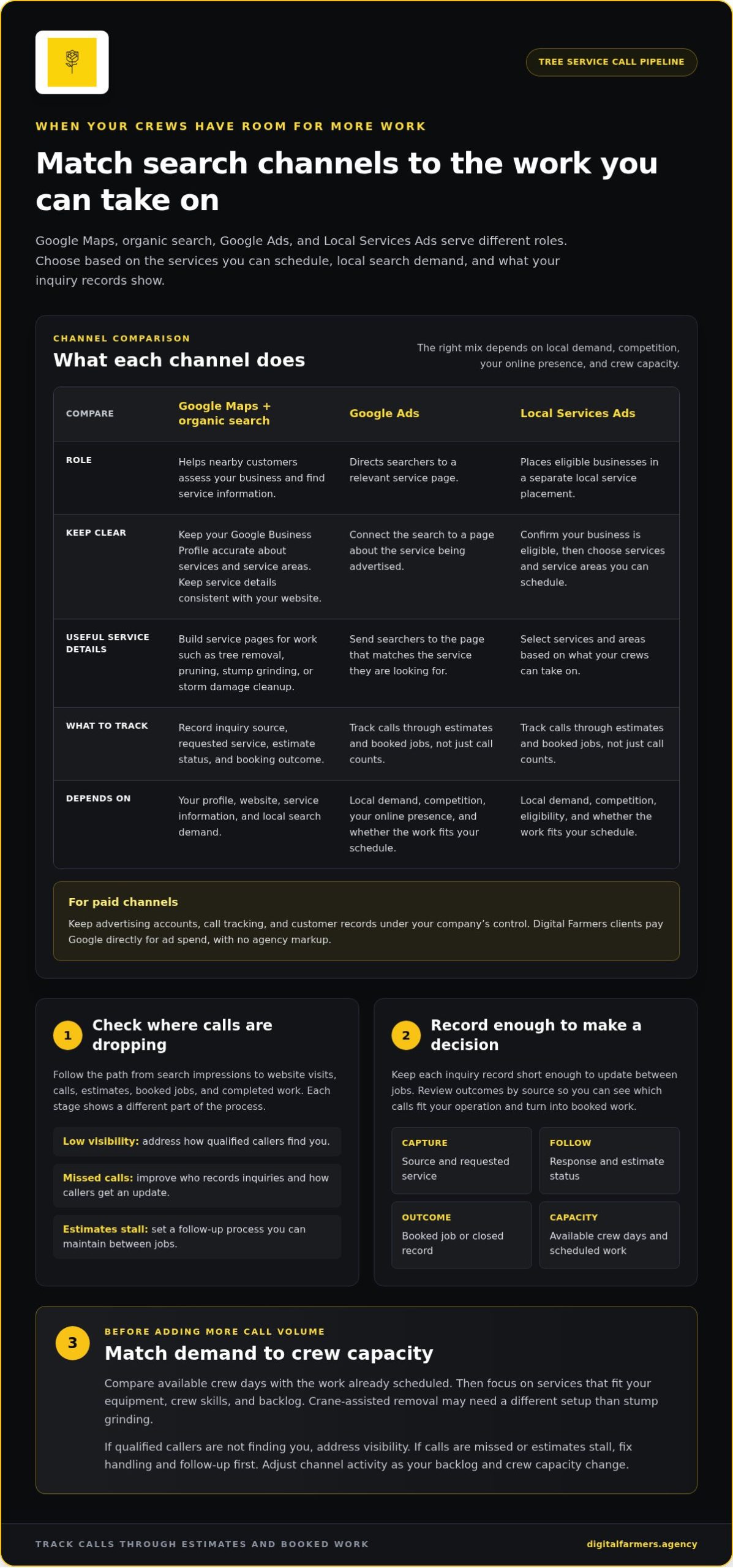
Once you know what work fits your operation, put your business in front of people searching for those services in your service area. Google Maps, organic search, Google Ads, and Local Services Ads can all contribute, but they do different jobs. What works depends on local search demand, competition, your online presence, and the work your crews can take on.
Use Google Maps and organic search to match service intent
Your Google Business Profile should accurately show the services you provide and the areas you serve. Someone searching for tree removal needs a clear path to that service, not a profile or website that leaves your work uncertain. Keep service details consistent across your profile and website.
Build useful service pages for the work you want to book, such as tree removal, pruning, stump grinding, or storm damage cleanup. These pages help potential customers understand what you do before they call. They also make the connection between the service someone searches for and your business clearer in organic search.
Maps and organic search support visibility in different ways. An accurate profile helps people assessing nearby providers, while organic search visibility depends in part on your website and its service information. Keep your profile current so callers can see which services and areas your crews support.
Use paid channels with clear ownership and tracking
Google Ads and Local Services Ads (LSA) are separate paid channels for reaching people actively searching for tree work. Google Ads can direct searchers to a relevant service page. LSA places eligible businesses in a separate local service placement. Choose services and service areas based on what you can schedule, then adjust activity as your backlog and crew capacity change.
Track calls from each channel through to estimates and booked jobs. A call count alone won’t show whether a campaign is producing suitable removal work, inquiries outside your service area, or jobs your crews can’t take on. Keep advertising accounts, call tracking, and customer records under your company’s control so you can connect marketing activity to actual outcomes.
With Digital Farmers, clients pay Google directly for ad spend, with no agency markup. Paid visibility can help capture existing search demand while organic visibility develops, but call quality still depends on your services, local competition, and follow-up. Before accepting more work, account for each job’s equipment, crew, and scheduling needs. OSHA’s tree care safety guidelines are a useful reference when planning field operations and job capacity.
To get more tree service calls without filling the schedule with poor-fit inquiries, match each channel to work your crews can perform. Use call and estimate outcomes to decide whether to maintain, adjust, or expand a channel.
Make your website and business profile turn searches into calls
A homeowner may find your company on a phone while comparing options or looking at a tree problem on the property. If the phone number is hard to spot, the service area is unclear, or the page doesn’t explain what you do, the visit can end without a call. Make the next step obvious.
Your website and Google Business Profile should give the same basic information: where you work, which tree services you provide, and how a customer can reach you. Conflicting details make it harder for callers to know whether you’re a fit. Accurate information also helps set expectations before you spend time returning an inquiry.
Give callers clear service and contact information
Put your phone number near the top of the mobile page and make it usable with one tap. State your service area in plain language. Don’t make visitors search through multiple pages to find out whether you handle tree removal, stump grinding, or storm damage cleanup.
Use a separate page or a clear section for each service you want to book. Describe the work in terms a property owner understands, then explain what happens after they request an estimate. Tell them what information to provide, how your team will respond, and what the next step is. Don’t promise a specific arrival time or outcome unless your operation can support it.
Keep the website aligned with your Google Business Profile, or GBP. If you stop offering a service, change your service area, or adjust what your crews can take on, update both. A profile that advertises work your operation no longer handles can produce poor-fit inquiries and waste time.
Build trust with accurate business information
Show real project examples that reflect your work. Label them accurately, and don’t imply that one completed job represents every site condition. Access, tree condition, equipment needs, and property layout can all affect a job, so useful details help callers understand your experience without overstating what the work involves.
List credentials only when they apply to your team. If your company has an ISA Certified Arborist or TRAQ-qualified professional, identify that credential accurately. Don’t use certifications, affiliations, or safety claims you can’t substantiate. Specific, correct information is more useful than broad claims.
Explain how a customer can request an estimate and what follow-up to expect. Keep the process consistent with how your office handles calls. A simple form can ask for the service requested, job location, and contact details, but it shouldn’t replace a visible phone number.
Review your website and profile when your services, service area, or crew capacity change. This keeps the information useful to callers and helps you get more tree service calls that fit the work your company can take on.
Turn answered calls into estimates and booked tree work
You can answer every call and still lose good work if nobody owns the next step. A caller may need tree removal, storm damage cleanup, or a pruning estimate. Move each qualified inquiry from first contact to a clear decision, without leaving follow-up to memory.
Set a repeatable response and follow-up process
Keep the sequence simple: answer, record the request, agree on the next step, and follow up. If you or your crew lead can’t answer while working, assign someone to return the call. Make sure that person knows which details to capture and how to route requests that need an estimate.
Record the caller’s contact details, requested service, and job location. Confirm that the location is within your service area. Then note the agreed next step, such as arranging an estimate, requesting more information, or closing the inquiry because the job isn’t a fit.
Give every open estimate a status. It may be scheduled, sent, awaiting a customer decision, booked, or closed. Use your CRM or customer database as the main record. Email or SMS can support follow-up where appropriate and compliant, but log the outcome in the same place.
Set a regular time to review missed calls and open estimates that fits your operation. This might be part of your office routine or a handoff to a team member. The point is consistency, not adding a task you can’t maintain during a busy stretch.
Read call results against crew capacity
Review qualified inquiries alongside estimates sent, close rate, booked work, backlog, and available crew days. Raw inquiry counts don’t show whether callers need services you provide, whether estimates are closing, or whether the schedule can absorb more work.
If qualified calls come in but few estimates get booked, inspect the handoff between the call and estimate. If estimates go out but don’t turn into jobs, review follow-up and the types of work being quoted. If the backlog is already pressing crew capacity, more calls may create delays instead of useful booked revenue.
Adjust marketing activity to match the work your crews can handle. Keep records of incoming inquiries and scheduled work, then use them to guide channel decisions. Stronger call handling should support the operation, not add pressure to a full schedule.
Choose the next marketing step based on the call pipeline
Your call records should point to the next move. If qualified searches are scarce, check visibility. If callers find you but don’t request estimates, review the website and profile. If estimates go out but don’t turn into booked jobs, look at follow-up and job fit before adding more marketing activity.
Use a market review to identify the actual constraint
A market review should examine local search demand, current rankings, Google Business Profile performance, website inquiries, and the path from first contact to booked work. Connect visibility to qualified calls, estimates, close rate, backlog, and crew capacity. Rankings alone don’t show whether marketing is producing work your operation can schedule.
Digital Farmers audits existing work before recommending changes. Keep channels and assets that still serve your business, then address the weak point shown by your call data. Market conditions, competition, and your starting point affect what changes make sense.
For example, Burnett Land and Tree built its website and Google Business Profile from scratch. After profile verification, the company generated 131 leads and 50+ calls shortly after verification. That example shows why the starting point and the stage being measured matter when you assess marketing performance.
Keep control of the acquisition system
Your company retains ownership of its domain, website, Google Business Profile, ad accounts, tracking, and creative assets. You also retain your CRM, customer data, and customer list. These are operating assets, not disposable campaign materials.
Digital Farmers can work alongside an in-house marketer rather than requiring you to discard useful work. Its contractual policy is to work with one tree service company per county. The right scope still depends on your market, call pipeline, and capacity.
Before changing channels, use the evidence you already have. Compare search visibility with qualified inquiries, estimate activity, bookings, and available crew days. If the records show a gap between calls and estimates, fix that handoff. If demand is limited, focus on the channels and service areas that fit your operation instead of spreading effort across every option.
The practical goal is to get more tree service calls that match your service area and can become scheduled work. A market review helps identify the next step without assuming every existing channel needs replacing.
Put the next step on the calendar
Choose your next marketing move based on search demand, qualified calls, estimate outcomes, and crew capacity. These signals can show where to focus without adding work your schedule can’t absorb.
Digital Farmers has been a Tree Care Industry Association member since 2025. The team audits existing marketing before recommending changes, and your company retains ownership of its marketing assets and data.
Use a county market review to see search demand, who is ranking, and what your profile and website are producing before anything changes. Learn more about Digital Farmers.
Keep the focus on work your crews can take on and book with confidence.
Frequently Asked Questions
How can I get more tree service calls from Google?
Start by matching your Google Business Profile and website to the tree work you want to book. Make sure people can find your phone number, confirm you serve their area, and see whether you handle work such as removals or pruning. Compare Maps, organic search, Google Ads, and Local Services Ads by qualified calls and booked estimates, not visibility alone. Your market and crew capacity affect the right mix.
Why is my tree service website getting traffic but not calls?
Visitors may not find a service that fits their need or a clear way to reach you. Test your site on a phone, including the tap-to-call number, service-area details, and estimate request form. Check that each page matches the service someone searched for instead of sending every visitor to a general page. If calls are still low, compare which pages attract visits with which ones produce inquiries before rebuilding the site.
Do Google Ads or Google Maps bring more tree service calls?
Neither channel is stronger in every service area. Google Ads can place your business in front of active searchers through paid placement, while Google Maps visibility depends on your profile and local search conditions. Compare the channels using calls that match your services, estimate requests, and booked work. Keep the comparison tied to the same service area and service type, since demand and competition can vary.
How quickly should I return a tree service call?
Return missed calls as soon as your operating schedule allows, and assign someone to handle them when you’re unavailable. There is no response-time benchmark that fits every crew schedule or season. Use a voicemail greeting that asks for the caller’s location and the work needed, then record the inquiry and next step. That gives you enough detail to prioritize relevant jobs without interrupting field work unnecessarily.
Should I buy shared tree service leads or generate my own calls?
Compare sources by the quality of their inquiries, how well they fit your service area, and whether they become estimates and booked work. Shared leads may involve other contractors contacting the same prospect, while owned marketing assets support calls directly to your company. Digital Farmers builds customer-acquisition infrastructure, and clients retain their marketing assets and data. Clients also pay Google directly for ad spend, with no agency markup.
What should I track to know whether marketing brings booked tree work?
Record where each inquiry came from and what happened after it arrived. Note the requested service, whether the caller was in your service area, whether you issued an estimate, and whether the job was booked or lost. A short lost-job reason, such as timing, job fit, or no customer response, can help explain a weak close rate. Review booked work against your backlog, not just the number of calls.
Can Digital Farmers work with my existing marketing team?
Yes. Digital Farmers can work alongside your in-house marketer or existing vendor, and audits current work before recommending changes. Your company retains its domain, website, GBP, ad accounts, tracking, creatives, CRM, customer data, and customer list. Your team can keep useful work in place while addressing a specific gap in the call pipeline. The right scope depends on what is working and where qualified inquiries are being lost.
Book a market review for your county. You see search demand, who is ranking, and what your profile and site are producing right now, before anything changes. Call +1 (603) 802-6879.