
Your schedule is packed, then a crew day opens up. Storm calls can pull people and equipment off planned jobs, while seasonal demand shifts the work customers need. To keep tree service crews booked, you need inquiry flow that fits the capacity you actually have, not a pile of leads with no room to serve them.
More inquiries don’t automatically mean more booked work. If you can’t see which calls turn into estimates, sold jobs, and backlog, you may keep spending while your crews are already stretched, or leave capacity unused when demand slows.
A workable plan starts with crew availability, the services you want to sell, and the season ahead. Match those needs to channels that support near-term demand, such as Google Maps and paid ads, while building longer-term visibility through SEO.
This article explains how to track inquiries through to booked jobs, adjust lead flow as capacity changes, and account for storm work without letting it run the whole schedule. The goal is steady demand and a manageable workload, not a calendar that looks full but can’t be delivered.
Key Takeaways
- Separate open crew capacity from unqualified inquiries, estimates waiting on follow-up, and jobs not yet scheduled.
- Match Google Maps, paid ads, SEO, customer follow-up, and optional direct mail to the work and capacity you need to fill.
- Compare booking approaches by control, customer data access, and visibility into which inquiries become booked jobs.
- Track qualified calls, estimates, booked jobs, lead source, and available crew time to adjust demand before the schedule gets overloaded.
- To keep tree service crews booked, coordinate marketing activity with crew capacity instead of chasing call volume alone.
Why tree service crews end up with open days or an overloaded schedule
Your crews need work on the calendar, but a busy phone doesn’t tell you whether next week is covered. Calls may come from outside your service area, ask for work you don’t offer, or go unanswered while you’re in the field. Even a suitable request can stall between the estimate and the schedule.
Several different problems can look the same from the office: open crew capacity, unqualified inquiries, estimates waiting for follow-up, or accepted jobs that haven’t been assigned a date. Each has a different cause. Adding marketing may increase calls without fixing slow estimating or gaps in the schedule.
An inquiry is a chance to sell work, not booked revenue. That distinction matters when you’re deciding whether to keep tree service crews booked or turn down additional demand to protect the work you’ve already promised.
Separate inquiry volume from booked work
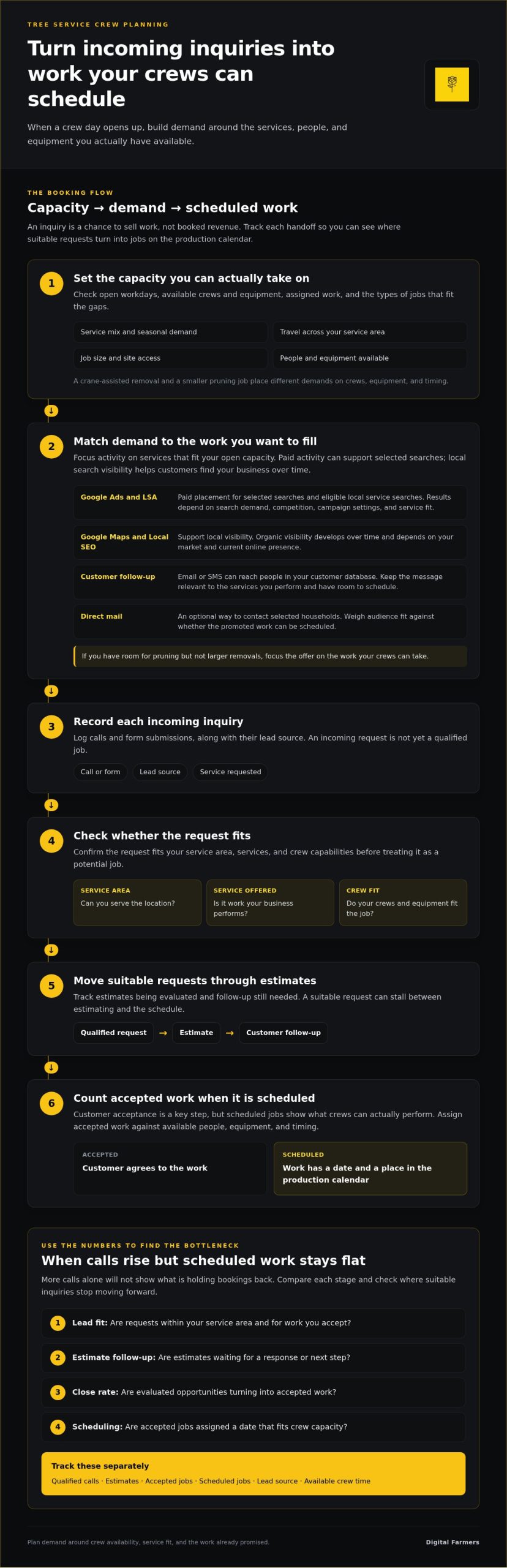
An inquiry is an incoming call or form submission. It becomes a potential job only after you establish that it fits your service area, services, and crew capabilities. Then it must move through an estimate, customer acceptance, and a scheduled date before it belongs in the production calendar.
Track each stage separately. Calls show demand reaching you; estimates show opportunities being evaluated; accepted and scheduled jobs show what crews can actually perform. If call counts rise while scheduled work stays flat, the issue may be lead fit, estimate follow-up, close rate, or scheduling. More calls alone won’t tell you which one.
Set demand against real crew capacity
Start with the work your operation can take on and the crews equipped to do it. That may include pruning, take-downs, stump grinding, storm damage cleanup, cabling and bracing, plant health care, land clearing, or right-of-way work. The mix changes with the season, weather, customer demand, and the employees and equipment available.
A crew’s practical capacity is more than the number of open days. Travel across your service area, job size, site access, equipment needs, and assigned work all affect what fits into a day. A crane-assisted removal and a smaller pruning job place different demands on people, equipment, and timing. Treating them as interchangeable slots can create delays or leave crews waiting between jobs.
Before increasing demand, identify open workdays, crew and equipment availability, and the types of jobs that fit those gaps. Allocate work against available resources, not just empty calendar space. Otherwise, seasonal rushes and storm calls can collide with existing commitments while quieter periods leave capacity unused.
How marketing channels support tree service bookings at different times
An open week and a full backlog call for different marketing activity. Paid advertising can put a service in front of people searching now, while local search visibility can help customers find you through Google Maps or organic results. Neither replaces answering inquiries and managing the schedule.
Choose channels for the booking need in front of you, not for call volume alone. If your crews have room for a particular service, focus activity there. If they’re committed, avoid creating demand you can’t serve on reasonable terms.
| Channel | Role in customer acquisition | What to weigh |
|---|---|---|
| Google Maps | Helps customers find your business in local search results | Profile accuracy and fit with the work you accept |
| Local SEO | Builds organic visibility for service-related searches over time | Search demand, competition, and your website’s starting point |
| Google Ads | Paid placement for selected searches and services | Campaign setup, inquiry quality, and current capacity |
| LSA | Paid local placement for eligible service searches | Lead fit and the process for handling calls and messages |
| Customer follow-up | Keeps communication with prior customers active | Service relevance and crew availability |
| Direct mail | Optional outreach to selected households | Audience fit and whether the promoted work can be scheduled |
Use faster channels and search visibility for different jobs
Google Ads and LSA are paid channels that can put your services in front of people searching. They don’t guarantee inquiries or bookings. Search demand, competition, campaign settings, and the match between the advertised service and your operation all affect the outcome.
Google Maps and Local SEO support visibility when customers look for tree services locally. Organic visibility develops over time and depends on your market and current online presence. A balanced plan can use paid activity for selected services while building local search visibility, but it still needs to reflect the jobs your crews can take.
Keep the offer specific. If you have capacity for pruning but not larger removals, don’t promote every service as though crew availability were the same. The right focus can change as your schedule and service mix change.
Use past-customer contact as a separate demand source
Email and SMS can support follow-up with people already in your customer database. Make outreach relevant to the services you perform and the work you have room to schedule. A broad message sent without regard to crew availability may produce requests that don’t fit.
Direct mail is optional, not a standard part of every plan. Treat it as another way to reach a selected audience, then assess whether the inquiries match your service area and available work. To keep tree service crews booked without adding work your crews can’t handle, coordinate outreach with the schedule and adjust the channel mix as capacity changes.
Compare booking approaches by control, fit, and visibility
A source can deliver customer requests while leaving you with limited control over the relationship or the information you can use afterward. Don’t compare sources by request volume alone. Consider whether you can identify the source, keep customer records, and see which types of jobs suit your operation.
With an owned marketing system, your website, Google Business Profile (GBP), ad accounts, CRM, and customer data remain under your control. Shared lead platforms work differently: your access to customer details and source information depends on the platform. That can affect your ability to build a customer database or assess which requests turn into work.
Digital Farmers builds owned customer-acquisition systems. It does not sell leads or rent access to another company’s audience. Clients own the domain, website, GBP, ad accounts, tracking, creative assets, CRM, and customer data. There is no markup on ad spend, and clients pay Google directly.
Assess ownership and control of the customer pipeline
Before changing providers or adding a source, take inventory of what your business can access. Check whether you control the account, can retrieve customer records, and can see the source tied to an inquiry. Keep existing work in place for review before deciding what should change. An in-house marketer or current vendor can continue working alongside an owned system.
Ownership doesn’t mean every source fits every business. It gives you a clearer basis for deciding how customer information and marketing assets support your own follow-up process.
Choose a channel mix that fits the work you want
Service type affects what a useful inquiry looks like. Tree removal may require the right crew and equipment. Pruning and stump grinding can have different scheduling needs, while storm damage cleanup may disrupt planned work and crew availability.
Choose sources and messages around the jobs you can take. If your crews have room for pruning but limited capacity for removals, make that distinction part of your marketing decisions. A request from the right source still needs to fit your services, equipment, and schedule.
Digital Farmers can review existing marketing before making replacement decisions and coordinate activity around your business priorities. The right approach depends on your market, crew capacity, follow-up process, and the customer information you need to manage the work.
Build a booking process that turns suitable inquiries into scheduled work
A workable booking process connects marketing activity to the crew calendar. It shows where inquiries come from, which requests fit your services, and where suitable jobs stall before scheduling. Without that view, you can increase activity without knowing whether it supports the work your crews can take.
Keep the process simple enough to use between estimates and field calls. Review it regularly, then adjust demand based on actual crew availability rather than call volume alone.
Track work through the estimate and booking stages
Record each inquiry’s source, requested service, service-area fit, and next action. Then track whether you sent an estimate, whether the customer made a decision, and whether an accepted job received a place on the schedule. A CRM or reporting process can keep these stages visible without relying on memory.
Include qualified calls to get more tree service calls, estimates, booked jobs, missed calls, follow-up status, and available crew time. Not every inquiry will become a job. The point is to diagnose why tree service leads are slowing down by seeing where suitable work moves forward or stalls, so you can address the right part of the process.
Adjust marketing activity when capacity changes
Use a short operating sequence: define crew availability, identify priority services, check inquiry sources, review estimates and follow-up, then adjust channel activity. If crews are full, focus on suitable future work rather than adding demand you can’t manage. If days open up, check current visibility and response handling before changing campaigns or replacing existing work.
For example, if your schedule has room for pruning but your removal crew is committed, promote pruning only if you have the staff and equipment to perform it. Changes in marketing activity should follow available capacity and the work you want, not a blanket push for more calls.
Results depend on your market’s search demand, competition, current visibility, website condition, service area, and follow-up process. A company with established local visibility starts from a different position than one with an incomplete online presence. No channel can make up for a poor fit between advertised work and available crews.
Your Google Business Profile (GBP) is one part of local visibility. Keep its core business details aligned with the services and areas you actually serve, then track whether profile activity leads to qualified inquiries. This Google Business Profile guide provides more detail on managing your listing.
Use the numbers to make measured changes. If qualified inquiries come in but estimates aren’t sent, fix the estimating process before increasing demand. If estimates go out but few suitable jobs are scheduled, review fit, follow-up, and the work being promoted. A market review can help you assess how marketing activity aligns with crew capacity.
Use an owned marketing system to support booked tree service crews
Keeping tree service crews booked takes more than running ads or updating a website. Search visibility, paid advertising, your website, inquiry tracking, and customer follow-up need to work together, with activity adjusted to the work your crews can accept. Digital Farmers coordinates these parts of customer acquisition for tree service companies. The system supports your booking process, but it can’t ensure an inquiry becomes a scheduled job.
That coordination also leaves room to keep useful work already in place. Existing campaigns and marketing assets are audited before changes are made. If you have an in-house marketer, the system can operate alongside that role rather than replacing it.
Keep the assets and customer data under your control
Your domain, website, Google Business Profile (GBP), ad accounts, tracking, creative assets, CRM, and customer data remain yours. That gives you access to the accounts and records needed to review where inquiries came from and what happened after the call. Reporting should connect channel activity with qualified inquiries and scheduled work, not stop at impressions or clicks.
Digital Farmers does not sell leads or rent access to another company’s audience. The work is focused on building and managing your customer-acquisition system, so your customer relationships and marketing assets stay with your business.
There is no agency markup on Google ad spend. You pay Google directly. That keeps the advertising account and its spend visible to you, while results still depend on market demand, competition, campaign setup, and whether incoming work fits available crew capacity.
Use a market review to assess the current booking gap
A market review looks at county search demand, competitors appearing in search, your profile, and website performance. It can help identify whether the booking gap starts with limited visibility, poor inquiry fit, or a breakdown between the first call and the schedule. The point is to understand the starting conditions before changing channels or increasing activity.
Digital Farmers works with one tree service client per county, with that exclusivity set by contract. That arrangement doesn’t mean every market is a fit. Search demand, competition, and your ability to serve the work all matter.
The system is designed to require roughly two hours per month of owner involvement. You remain responsible for crew capacity, estimates, and the jobs you accept. Marketing and reporting support your decisions, but they can’t account for a storm, a crew absence, or a job that takes longer than planned.
Set the next season up with a workable plan
A steadier schedule starts with decisions grounded in your crew calendar and the work your company can deliver. Use the information coming through your phone and website to identify where bookings stall, then make changes that address that gap. The aim is to keep tree service crews booked without accepting work your operation can’t handle.
Digital Farmers has been a Tree Care Industry Association member since 2025. The agency’s work focuses on the realities behind your schedule, from seasonal shifts to the different demands tree jobs place on crews.
For a clear view of your county’s search demand, who is ranking, and what your profile and website are producing before any changes are made, use the market review information.
Frequently Asked Questions
Can marketing keep crews booked if the schedule is already full?
No. Marketing can’t create more crew capacity, and adding inquiries may create a backlog you can’t serve. If your schedule is full, decide which future jobs you’re prepared to book and give customers realistic scheduling expectations. Keep notes on service type and requested timing. When capacity opens, use those notes to assess whether to adjust marketing activity based on your crews, job mix, and market conditions.
How do I keep tree service crews busy when storm calls stop?
Build demand beyond storm response by promoting work your crews can perform between storms. Review your available capacity for pruning, stump grinding, plant health care, and land clearing, then make those services visible to customers searching for them. Past customers may also be relevant for follow-up. Which jobs you can book depends on seasonal conditions, crew skills, and what is already on the calendar.
What should I track to see whether marketing is booking tree service work?
Track each inquiry from source to outcome, and separate requests that fit your services from those that don’t. Record estimates sent, customer decisions, jobs scheduled, and remaining crew time. During a schedule review, compare these records by service type. If pruning inquiries turn into estimates but aren’t being scheduled, that points to a different issue than having no pruning inquiries at all.
Should I pause Google Ads when my tree service crews are booked?
Not automatically. First decide whether you still want future bookings and which services have room in the schedule. If you’re accepting work further out for one service but not another, adjust campaign settings to reflect those priorities. Check whether calls are being handled and what the current campaign is producing before making changes. The right decision depends on your market, campaign setup, and expected crew availability.
Can one marketing channel keep tree service crews booked all year?
No single channel controls seasonal demand, competition, call handling, or the hours your crews can work. Google Maps, Local SEO, Google Ads, LSA, and customer follow-up can each contribute inquiries in different ways. Use more than one source where it fits, then review whether inquiries match the jobs and capacity you have. The right mix depends on your services, current visibility, and market.
How much owner time does managing marketing for a tree service take?
Digital Farmers’ approach is designed to require roughly two hours per month of owner involvement. You still need to set priorities, share changes in crew availability, and decide which services you want to book. A CRM or reporting process can help you review the information without relying on memory. Actual involvement depends on your current setup and the work that needs attention.
Book a market review for your county. You see search demand, who is ranking, and what your profile and site are producing right now, before anything changes. Call +1 (603) 802-6879.